Andrew Curran reports that a CrowdStrike report suggests a single person may have carried out a cyberattack on major South Korean banks using a stack of open-source and commercial AI tools, including Claude Code and Grok. The claims are as relayed in the post.
Last week some of South Korea's biggest banks were hit by a cyberattack. Thanks to a report from CrowdStrike tonight, we now know the entire hack may have been done by a single person. He used a combined stack of an open-source AI penetration tool named ARTEX, DeepSeek v4.1-Flash, GLM-5.3, Grok 4.6, and Claude Code.
Actor and politician Kamal Haasan responds to Elon Musk, arguing no billionaire should dictate national policy and that India should welcome affordable satellite internet from domestic and global providers. He also cites a CAG audit finding that BharatNet is struggling to meet its objectives.
Mr. Musk, yes, no billionaire should dictate a nation’s policy - Indian or American.
India must welcome competition in satellite internet, from Indian and global providers, whoever offers the most practical and affordable last-mile solution for those in remote regions. In countries with lower per-capita incomes, satellite internet must be affordable too. High subscription fees and equipment costs risk putting it beyond the reach of ordinary households. Connectivity must bridge the digital divide, not create a new one.
India knows our networks and spectrum are strategic infrastructure, not merely commercial assets. India’s national security safeguards are non-negotiable.
Every country makes choices based on its own interests. Those in the West cannot preach free markets while practicing protectionism at home. USA imposed 100% tariffs on Chinese EVs to protect its domestic industry, just as India takes measures to protect its own domestic manufacturers. Both India and the US have restricted Huawei over security concerns. One cannot demand a level playing field from others only when it suits its own agenda.
Indians will internally debate, question and address our strengths and shortcomings as a democratic country.
Take BharatNet, India’s programme to bring broadband to village-level local bodies. We will question why, as the CAG’s 2026 audit report found, the programme is struggling to meet its original objectives. Why were only 33.2% of service-ready Gram Panchayats operational, despite ₹39,888 crore being spent? At the same time, we know to appreciate our telecom sector and regulations, which has made internet data among the world’s most affordable, bringing millions online.
India is a democracy, not a colony. We welcome the world, but we, the Indian people, will decide our own future - not Western vested interests, their double standards or any billionaire - Indian or American.
Starlink is licensed in over 165 countries and has spent five years complying with every single law and requirement of the government of India, so why still no license?
The analysis examines China's stated AI safety positions alongside its actual regulatory and lab behavior, arguing Beijing prioritizes rapid development and tightly regulates AI applications and outputs while leaving frontier-model risk largely unregulated. It draws implications for US labs, investors, and policymakers.
SemiAnalysisby Mark Chen··✉ newsletter
“We think China's real approach to AI safety is speed-based, not safety-based.”— Mark Chen
Balaji Thotadri argues India should enforce its Digital Personal Data Protection Act now by naming Google, Meta, Amazon and Microsoft as Significant Data Fiduciaries. He responds to a PTI report that the US suspended several Indian IT firms from a labour certification program.
India already has a good option to respond .. sitting unused: the DPDP Act. Rules notified in Nov 2025. The tough obligations for Big Tech only start in mid-2027. Pull that date forward.
Name Google, Meta, Amazon and Microsoft as Significant Data Fiduciaries. That means annual audits, impact assessments, algorithm reviews, and Delhi deciding which Indian data never leaves India.
No ban. No new law. No WTO fight. Just enforcing what Parliament already passed.
They audit our hiring. We audit their data. Fair is fair.
A Breaking911 video reports President Trump presenting the National Medal of Science to Sergey Brin, Jensen Huang, Elon Musk and Lisa Su, and the National Medal of Technology and Innovation to Michael Dell and Satya Nadella.
President Trump presents the National Medal of Science to Sergey Brin, Jensen Huang, Elon Musk, and Lisa Su, and the National Medal of Technology and Innovation to Michael Dell and Satya Ndella.
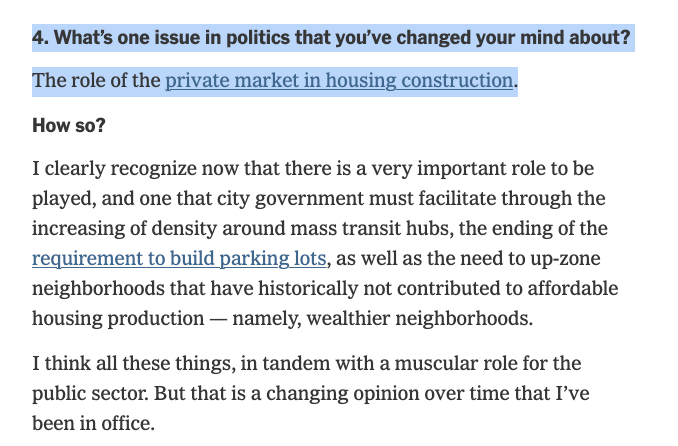
Matthew Zeitlin shares a New York Times interview in which Zohran Mamdani says he has changed his mind about the role of the private market in housing construction. The post quotes a developer touting market-rate projects in democratic socialist districts.
Private developers are essentially bragging about still being able to do market-rate development in districts represented by democratic socialists therealdeal.com/new-york/2026/08/07/nyc-commie…
Economist Noah Smith argues that top US schools are mostly discriminating against Indian applicants rather than Asian applicants broadly. He cites a quoted post reporting that white applicants with 1550+ SAT scores were admitted to Columbia at about twice the rate of South Asians.
White applicants with a 1550+ SAT get into Columbia at twice the rate of South Asians with the same scores (17% vs 8%), and slightly above East Asians. twitter.com/blancmontagnard/status/21075852600…
Dr. Anish Koka shares an analysis of leaked Columbia admissions data that separates East and Southeast Asian applicants. He reports that Southeast Asian applicants with near-perfect SAT scores had an 8% acceptance rate versus 16-17% for East Asians and whites.
If you have a kid applying to college with the last name of Patel or Koka or Reddy you may want to know what your kid is up against: (it’s worse than I thought)
Tx to @zagrebbi we have an analysis of leaked Columbia data that disaggregates Asian as a group into South East Asian and East Asian.
East Asians with a near perfect 1550+ SAT score have about the same rate of acceptance as whites (16-17%)
Southeast Asians (Patels/Kokas) with the same near perfect SATs have an 8% acceptance rate. (Sorry to report to white nationalists — there is no mafia of Indians at elite schools in the U.S. that favor Indians)
Other notable findings— there are comparatively few self identified black/Hispanics with 1550+ SATs. (Current NYC mayor Zohran Mamdani self identified as black when applying to Columbia). Acceptance rates for black/Hispanic identified individuals is 25-50%
Aviator Anil Chopra shares an Inshorts report claiming Iranian fighter pilots bombed US bases without GPS, relying on paper maps. The post links to the news summary and includes a photo.
A post warns of election interference after the administration reportedly refused OSCE observers for the first time in over two decades, a choice that aligns the U.S. with Russia and Belarus. The Justice Department is reportedly preparing to send its own poll monitors.
Trump administration refuses international election monitors for first time in over 2 decades.
The decision not to invite observers from the OSCE puts the U.S. alongside Russia and Belarus, while the Justice Department prepares to deploy its own poll monitors. ms.now/news/trump-midterms-osce-election-obser…
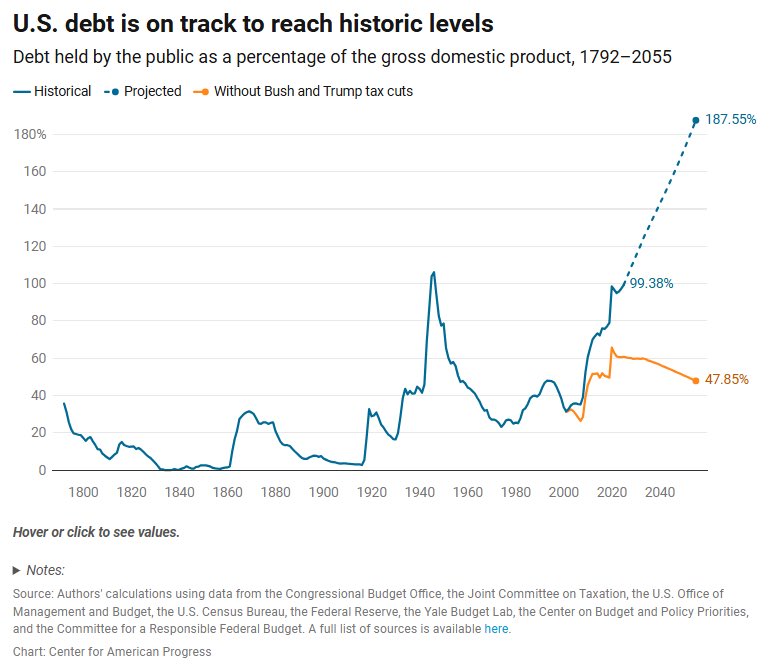
Bobby Kogan argues that Paul Ryan voted for tax cuts that worsened debt repeatedly across his career, and notes he retired at 55. He is responding to a post suggesting Ryan could return to politics in 2028.
Paul Ryan took debt so seriously that he voted for the tax cuts that did this at only 31 years old, and again at 33 years old, and again at 40 years old, and again at 42 years old, and again at 47 years old.
He retired before he could do it yet again at 55 years old.
FWIW, Paul Ryan is only 56 years old. In our age of absolute fiscal irresponsibility, what if the man who took tackling the debt seriously pulls a Winston Churchill and suddenly comes back onto the scene with serious momentum in 2028?
A post recounts that Instagram co-founder Mike Krieger came to the US on an F-1 visa, moved through OPT to an H-1B, and later self-deported amid delays. It argues that a proposed $100,000 H-1B fee would have prevented Instagram's creation.
Instagram co-founder Mike Krieger came to the US on an F-1 visa and then used OPT to get an H-1B. He later decided to self-deport and told Kevin to find a replacement because his H-1B transfer kept getting delayed.
If this administration was in 2010 they would've abused Mike for stealing an American's job, coming on F-1 and using OPT to get H-1B. If the $100k order was passed, Mike would've returned back to Brazil and we wouldn't have Instagram.
International Cyber Digest reports that ransomware group BYOD leaked personal data of 3,615 Trump Mobile customers, including names, addresses and order details, and claims continued access to the company's backend. Straight Arrow News reported that people in the data confirmed its accuracy.
‼️ BREAKING: Trump Mobile customers have had their personal data leaked by ransomware gang BYOD. The dump covers 3,615 people and includes names, emails, phone numbers, home addresses and order details.
The gang says the company answered news of the breach with "We have no team to handle this."
The leak includes the Trump Organization's own CIO, who oversees its information security.
People listed in the data confirmed their details are accurate and BYOD claims it still has access to Trump Mobile's backend, Straight Arrow News reports.
Daniel Di Martino says a new rule charging $70,000 for OPT and $30,000 for STEP OPT rests on an unrealistic 44% demand drop assumption, and warns it will harm innovation and cost taxpayers.
It assumes demand drops by 44%, which is an arbitrary and incredibly optimistic scenario. There is no indication that universities will pay this, demand will drop 99%.
This is bad for innovation, and will cost taxpayers.
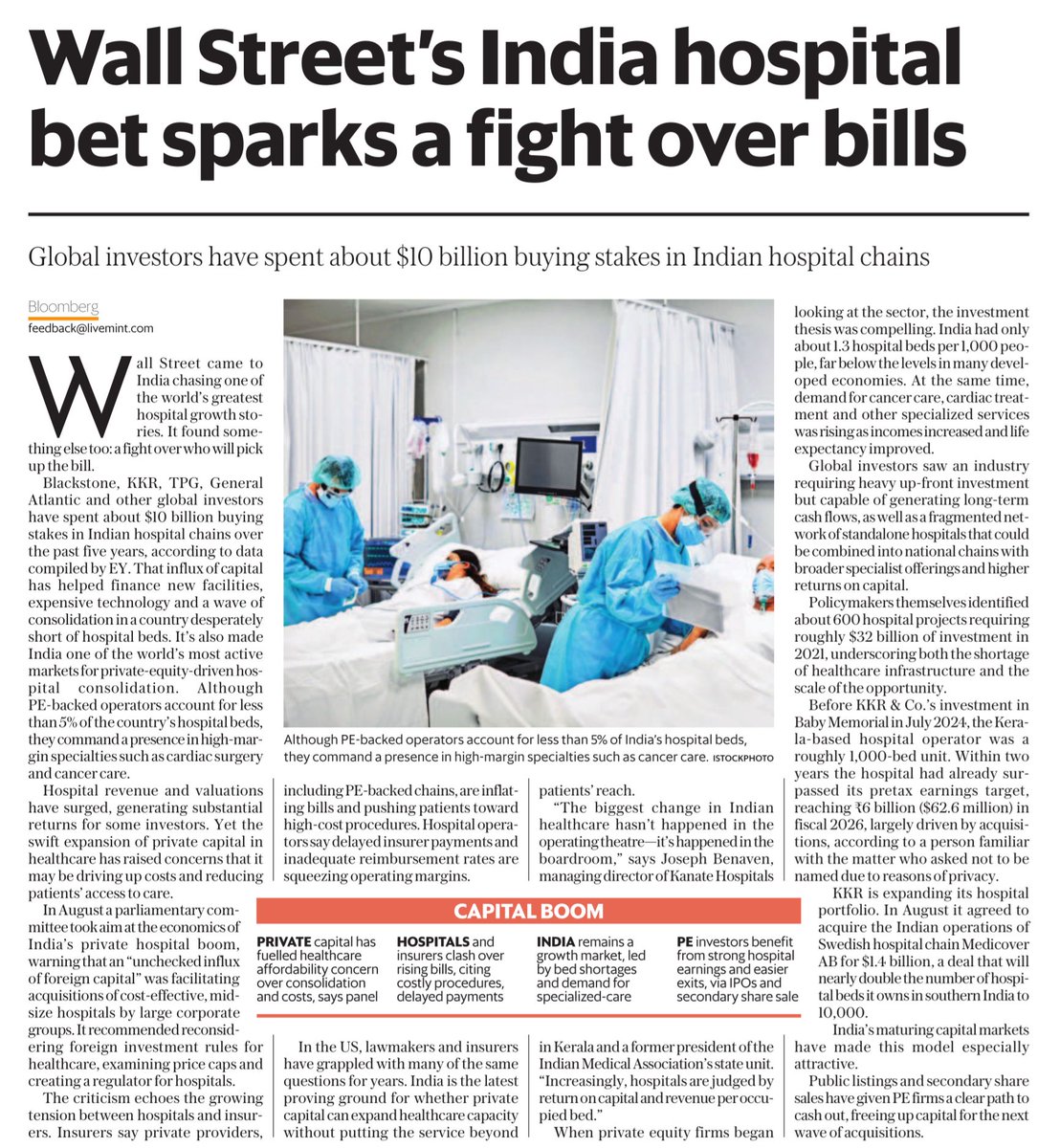
Abhishek Basumallick argues that the corporatization of Indian hospitals should be stopped, criticizes the U.S. healthcare model, and proposes regulating hospitals as public utilities with fixed returns like power companies.
Kim-Mai Cutler responds to a New York Times interview in which Zohran Mamdani said he changed his mind about the role of the private market in housing construction. Her post is a brief quip with no further argument.
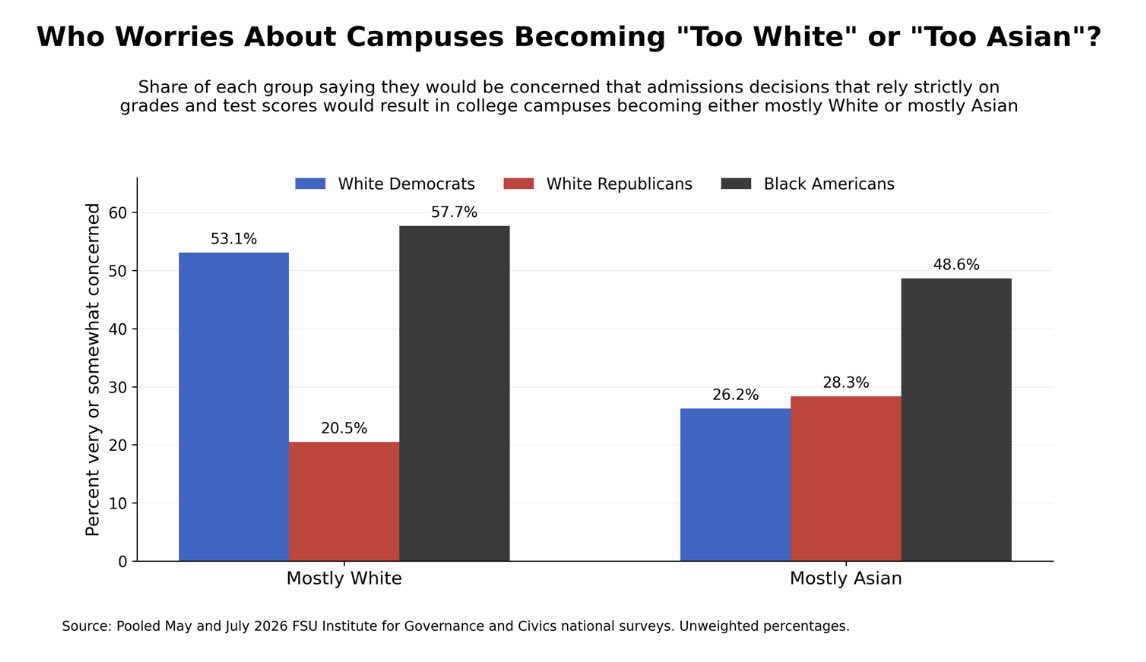
Renu Mukherjee shares research by Michael Hartney finding that only 28% of white Republicans and 26% of white Democrats worry about campuses becoming mostly Asian, and argues the political positions taken on social media may cost candidates support.
Incredible new research from @MichaelTHartney: The Heritage American/Bo French/Woke Right’s position on college admissions is a political loser—even among white Republicans.
ONLY 28% of white Republicans said they were worried about campuses becoming “mostly Asian.” Similarly, only 26% of white Democrats expressed concern. Black Americans were the group most worried about a majority-Asian campus, albeit still under 50% were troubled by the prospect.
X isn’t real life. And if political candidates treat it like it is, then they’re probably going to lose—and they deserve to.
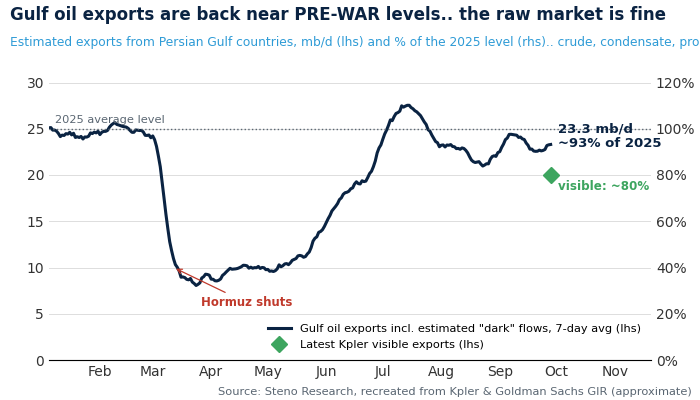
A short post by Andreas Steno Larsen asserts that the United States has essentially won the Hormuz confrontation, accompanied by a photo. The post offers no supporting detail.
Economist Noah Smith posts a brief one-line statement that the situation reflects unimaginable levels of corruption. The post provides no specifics about the subject.
Noah Smith criticizes Christopher Rufo for defending meritocracy when it concerned Black versus White outcomes, yet denouncing it when Indian Americans succeeded. He shares a quoted post from The Atlantic thread on the topic with photos.
Rightists will scream "Colorblind meritocracy!" right up until the point where Indian people start doing well, at which point every rightist turns into Ibram Kendi twitter.com/TheAtlantic/status/210637374192397…
Aakash Gupta argues that Purdue Pharma's guilty pleas and fines failed to deter fraud, as the Sackler family extracted $10.7 billion and the conspiracy continued. He uses this to argue against relying on lawsuits to govern AI, responding to Bill Gates's remarks on AI safety.
In 2007, Purdue Pharma pleaded guilty to lying about OxyContin's addiction risk. The fine was $635 million. Over the next decade, the family that owned Purdue pulled $10.7 billion out of the company.
Bill Gates got asked this week whether lawsuits and corporate self-interest are enough to keep AI safe. He pointed at opioids and called the idea insane. The record backs him up harder than most people realize.
Before the guilty plea, payouts to the Sacklers ran $1.3 billion over twelve years. After it, $10.7 billion in ten. A criminal conviction taught them to move money out of the company faster. OxyContin sales kept growing after the fine.
Here's the detail that should end the debate. When Purdue pleaded guilty a second time in 2020, it admitted the conspiracy to defraud regulators ran from May 2007 to March 2017. May 2007 is the same month as the first guilty plea. The fraud restarted before the ink dried.
The final ledger reads like satire. More than half a million Americans dead from opioid overdoses. Purdue in bankruptcy. The Sacklers settling for $6.5 billion paid out over 15 years, no admission of wrongdoing, nobody in prison.
Liability ran a 20-year live experiment as the safety system for a dangerous product. Every lawsuit happened. Deterrence never showed up, because fines land years after the damage, on whatever shell remains, while the profits moved out long before.
That's why the FDA reviews drugs before they ship, why planes get inspected before takeoff, why cars have to include seat belts.
Gates called AI "the most dangerous thing that humans have ever gone near." You can argue with him on that. But governing it with lawsuits was already tested once, and the people who ran that test kept most of the money.
Garry Tan recounts an interview with Transportation Secretary Sean Duffy about modernizing air traffic management. Duffy cites the SMART tool from Air Space Intelligence, which predicts congestion and helps spread flights, with controllers still making final decisions.
I asked Secretary Duffy what Americans should be able to do, if we get this decade right, that they can't do today.
Sean Duffy is the Secretary of Transportation, and he sat down with me at our Startup Industrial Base event in DC today. He went straight to how our country's air traffic gets managed.
At the command center, people sit in front of six screens with a paper flight chart above them, trying to make the calls on weather and routing.
His example: four planes reach the same runway at the same time and only one can land. See it two hours out, speed up two, slow one down, and each one lands when the runway is open. "Like, not complicated stuff, but we don't do any of this."
Paper and pencil and minimal human augmentation from software looks like this: Say an airport can take 15 planes in a 15 minute window. "Well, the airlines will schedule 32." He says he's handing the airlines that data and asking them to spread out.
The tool is SMART, from Air Space Intelligence, a small company he says competed with the biggest companies and won. It predicts. His stage example: a 2.5 hour ground stop might only need 45 minutes. He's taken heat for supposedly handing air traffic control to AI. Duffy's answer? "it's dumb AI, not smart AI." Controllers still make every call.
None of this needs a breakthrough. It needs the will of the people to know they need to use software and be ok with AI augmentation instead of insisting on a paper chart and copper wire.
Noah Smith reacts to a Watcher Guru report that a former senior Federal Reserve official was blackmailed by a Chinese spy after sending nude photos from a government phone via an Asian dating site.
JUST IN: 🇺🇸🇨🇳 Former Senior Federal Reserve official was blackmailed by Chinese spy after using Asian dating site and sending nude photos from his government phone.
Dr. Joseph Younis responds to claims of H-1B fraud among residency programs, arguing that international medical graduates fill primary care and rural positions because U.S. medical schools produce far fewer graduates than available residency slots. He contends the root problem lies in medical school admissions, not in the programs or the IMGs themselves.
Again, the vast majority of this is not H1B fraud.
What you’re looking at is a cherry-picked list of community programs that are forced to accept IMGs because U.S. medical schools train 15,000 less medical graduates compared to available residency spots. In 2025, for example, there was 52,577 American college students who applied to medical school and only 22,262 were accepted. BUT, in 2025 there was also ~40,993 residency slots. When you add U.S. MDs and U.S. DOs applying to residency in 2025 you got roughly 27,498. That’s 13,495 short.
Who fills them? Two: U.S. IMGs (American international medical graduates) and non-U.S. IMGs (those are the “foreign” doctors you’re referring to).
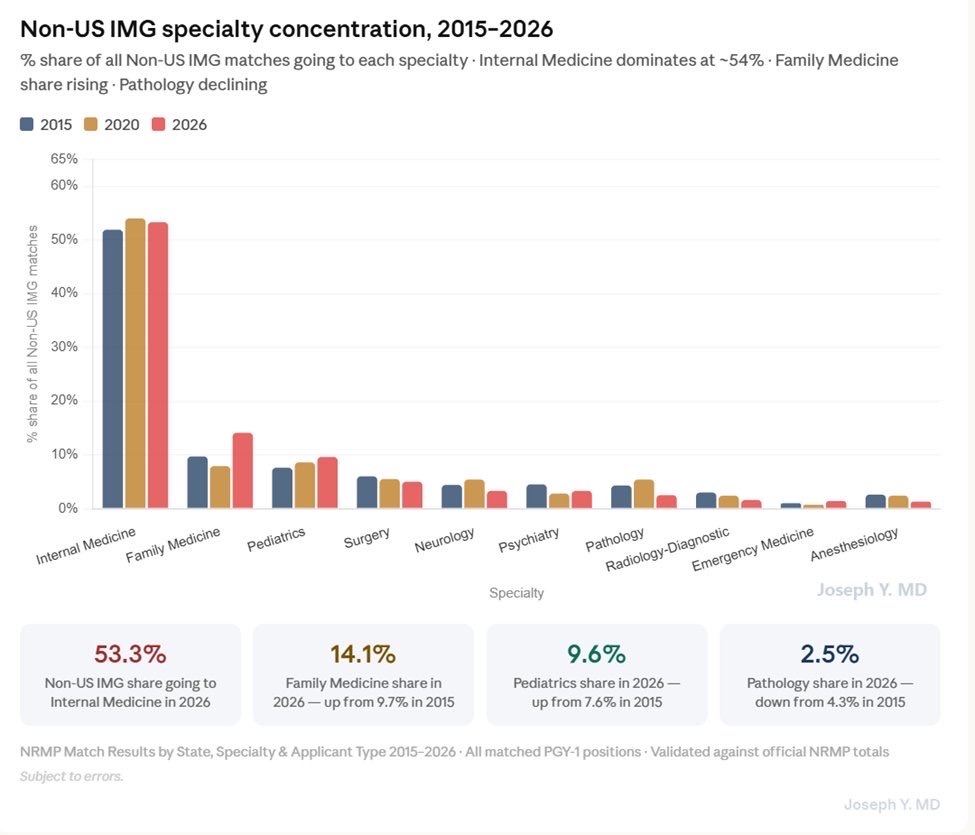
Now, where do these IMGs match? Overwhelmingly in primary care and rural-suburban programs, which historically are areas US MDs don’t prefer. However, AND THIS IS IMPORTANT: JUST BECAUSE US MDs DONT PREFER IT DOES NOT MEAN THEY WOULDNT DO IT IF THAT WAS THEIR ONLY OPTION. Check charts below.
The evidence shows that 67-85% of US MDs would rather take ANY specialty and program over waiting just one more year to try again.
So what does this all mean? 1. The problem is not IMGs 2. The problem is not residency programs 3. The problem is upstream, at the medical school level. Why do we have ~52,000 Americans trying to get into med school and we turn away 58% of them? 4. IMGs are filling a need in a vacuum we created. Getting rid of IMGs would collapse healthcare in its current state 5. No, it’s not true that “Americans wouldn’t take those jobs anyway.” This is a scapegoat that lacks nuance. The match data is evidence against it. We shouldn’t invent arguments to mask bad policy 6. Bad policy persists only when incentives are involved. So who’s involved is the question you should be asking instead of racially targeting doctors. 7. The truth is we do need a diverse workforce, data shows patient-physician congruence is an important aspect of care management 8. We need to stop screwing over American students
It can all be true. This is a complex issue that’s cemented for 100 years now.
Look at this chart. These are American residency programs.
Red = foreign resident doctors. Grey = Americans.
Some hospitals are almost 100% foreign. A lot of these doctors came in on visas. Some have been tied to fake credentials and USMLE cheating scandals.
I pay the premiums. I wait months to be seen. Taxpayer-funded Medicare GME money(over $21 billion a year) is training these foreign doctors instead of Americans.