Aakash Gupta recounts how screenwriter Adele Lim left the Crazy Rich Asians sequel after a pay dispute, stalling the franchise for years. He notes she now serves as HBO series showrunner through her company 100 Tigers, with the cast and Jon M. Chu returning.
The sequel to a $239 million movie fell apart over a $110,000 offer. And the writer who walked away just got handed the entire franchise.
Crazy Rich Asians cost Warner Bros $30 million in 2018 and grossed $239 million worldwide. First studio film with an all-Asian cast since The Joy Luck Club in 1993. A sequel should have been greenlit before opening weekend ended.
Instead the franchise went dark for seven years.
The unraveling started with the pay offers. Co-writer Peter Chiarelli, the veteran who wrote The Proposal, was offered $800,000 to $1 million for the sequel. Adele Lim, the writer Jon M. Chu brought in to give the script its cultural voice, was offered around $110,000. Chiarelli offered to split his own fee with her. She turned it down, said what she makes shouldn't depend on the generosity of the white-guy writer, and quit.
Warner Bros came back months later with an offer near parity. She passed on that too.
Without her, the sequel never recovered. Chu left to make In the Heights and then Wicked. Two separate sequel attempts collapsed. The most bankable rom-com of its decade produced nothing for most of a decade.
Now look at the structure of what got announced. The HBO series runs through Lim's own production company, 100 Tigers, with Lim as showrunner, writer, and executive producer. Chu and Kevin Kwan are EPs on her show. Constance Wu, Henry Golding, and Michelle Yeoh are all back.
In 2019 the studio wouldn't match her co-writer's $800,000. In 2027 the same studio is putting the whole franchise in her hands.
Walking away from the biggest credit of her career looked like a terrible move for a first-time feature writer. It turned out to be the trade that got her everything.
From Jon M. Chu and Adele Lim, #CrazyRichAsians will continue as an HBO Original Series starting production in 2027. Constance Wu, Henry Golding, Ronny Chieng, and Michelle Yeoh reprise their roles based on Kevin Kwan's bestselling books.
Greg and Taylor argue that short documents signal human thinking, since AI writes long by default. They advise keeping decisions to 1-2 pages while letting AI handle long plans for agents.
Werner Zagrebbi cites admissions figures claiming white applicants with 1550+ SAT scores were admitted to Columbia at twice the rate of South Asians (17% vs 8%). The post quotes a contentious thread about ethnic admissions dynamics.
White applicants with a 1550+ SAT get into Columbia at twice the rate of South Asians with the same scores (17% vs 8%), and slightly above East Asians.
But they're not outscoring us. Our top scorers are dropped and denied entry while their ethnic mafias form total controlling shares of admissions boards. Don't make this about us losing on a meritocratic stage. What the fuck is the point of that. "Guys Indian Big Brahmin Cortex.. twitter.com/herandrews/status/2107550972667158…
Amock_ praises Sabeer Bhatia for posting about a documentary and calls the film remarkable. Bhatia's quoted post invites followers to join him in watching the film together. The post includes a video.
Claire Vo says many mothers, including those in tech, are slow to adopt AI due to privacy, environmental and workplace concerns. She argues the market is missing agents that manage family logistics like calendars, bills and errands rather than one-off tasks.
As one of the most tagged AI mother of bots in this thread let me tell you a secret: a lot of moms (even moms in tech) are the slowest f-ing adopters of AI I know.
I’m in a bunch of random mom groups and I hear - I won’t connect my email cal whatever - water / data centers etc - get all AI out of my kids schools - here is my 10000 word prompt for chat - I hate AI in my job, burn out, get me out of tech
If you get off X and into the real world, the adoption curve is slow. My YT channel is over 90% men. Women + moms are being left behind, and it’s not because someone hasn’t designed the right agent yet.
Silicon Valley keeps building me a husband when what I really want is a wife lol
I don't want an agent that only does one-off, random tasks that are nice but not life-changing: booking flights, making dinner reservations, or buying tickets
I want an AI wife who knows what’s on the family calendar, remembers there’s a birthday party Saturday and we haven’t bought a gift then sends me options, realizes we’re almost out of diapers and buys them, knows which bills are coming up, remembers someone needs a dentist appointment and books it, figures out what the hell we’re eating all week and what w…
Hux summarizes remarks by Alexandr Wang on separating from most people through focus, over-delivery and targeted effort rather than raw intelligence. The post presents his three principles in Chinese with a video attached.
Acyn shares a video clip of Jeff Bezos advising voters to distrust politicians who point fingers instead of offering solutions. He says he would quickly exit executives who blame people rather than fixing root causes.
BEZOS: When you're in the polling booth and you're thinking about who you're going to vote for, think about this. If there's a politician that is picking villains and pointing fingers, that's probably means they don't have a solution
If there's an executive at one of my companies, instead of working on a root cause and a real fix, all they did is point fingers and blame people, we would exit them quickly.
Packy McCormick recounts an interview at a hedge fund on 9 West 57th Street with a young global head of credit who had reportedly made about $2 billion on distressed bets. He reflects that the hour was intimidating because he is not a credit investor.
A long time ago, I interviewed with a hedge fund at 9 W 57th in a conference room with the most incredible views of the entire Central Park with a late 20-something who'd made the firm something like $2 billion on massive distressed credit bets the year before and had just been named its global head of credit. The next year I read he pulled in over $100 million, and he'd go on to lead the firm.
One of the most intimidating hours of my life. Not a credit guy.
Unburdened By What Has Been — 9 West 57th Street will be as important to the next generation of company-building as Letterman Drive was to the last. Long Lake and Thrive Holdings are products of an explicit acknowledgement that
Aakash Gupta reports that the FBI arrested Edward Frith after Epic Games reviewed a reported voice clip of his threat and sent it to authorities, and explains how Fortnite's rolling five-minute voice buffer and reporting system work.
The FBI just arrested a Fortnite player using a recording the game made of his own voice. He had no idea his headset was taping him. Almost nobody playing does.
Edward Frith, 29, had logged into his account over 1,700 times. In September he told another player that if the FBI showed up at his door he'd shoot them too. Someone in the lobby pressed the report button. Epic reviewed the clip, sent it to the FBI on September 20, and agents arrested him within days.
The design of the system is the clever part.
Recording every player would be a privacy disaster and a storage bill nobody wants. So Epic built voice reporting in 2023 to work like a flight recorder. The audio buffer lives on your own device, overwrites itself every five minutes, and never leaves your machine unless another player in the match reports it. The moment someone does, the clip gets packaged and sent to Epic's safety team with the speakers tagged.
He said it to one stranger in a lobby. That stranger had a button that turns the last five minutes into a federal exhibit.
I was a producer on Fortnite, and this is the part people outside the building never see. Threats of real-world violence got treated with the same urgency as a revenue outage. The game is full of kids, and Epic acts like it.
Fortnite is actually the conservative version of this. It still requires a human to press the button. Call of Duty has run AI moderation directly on live voice chat since 2023, no report needed. Every major platform with a microphone is converging on the same architecture.
The era where anything said into a gaming headset stayed in the lobby is ending one match at a time.
Aakash Gupta explains that Shazam's 2002 system, invented by Stanford PhD Avery Wang, used spectrogram peaks, constellation maps and hash lookups instead of AI, and was published openly in 2003. Apple acquired the company in 2018.
Shazam could name any song back in 2002, on flip phones, with zero AI. You dialed the number 2580, held your phone up to the speaker, and hung up. 15 seconds later, a text came back with the song name. That same core trick still runs the app today.
The inventor was Avery Wang, a Stanford PhD in audio signal processing. His problem was brutal. Match a short clip recorded on a 2002 cell phone mic, in a noisy bar, against a database of a million songs, in seconds, over a phone call.
His solution treated music as geometry instead of sound.
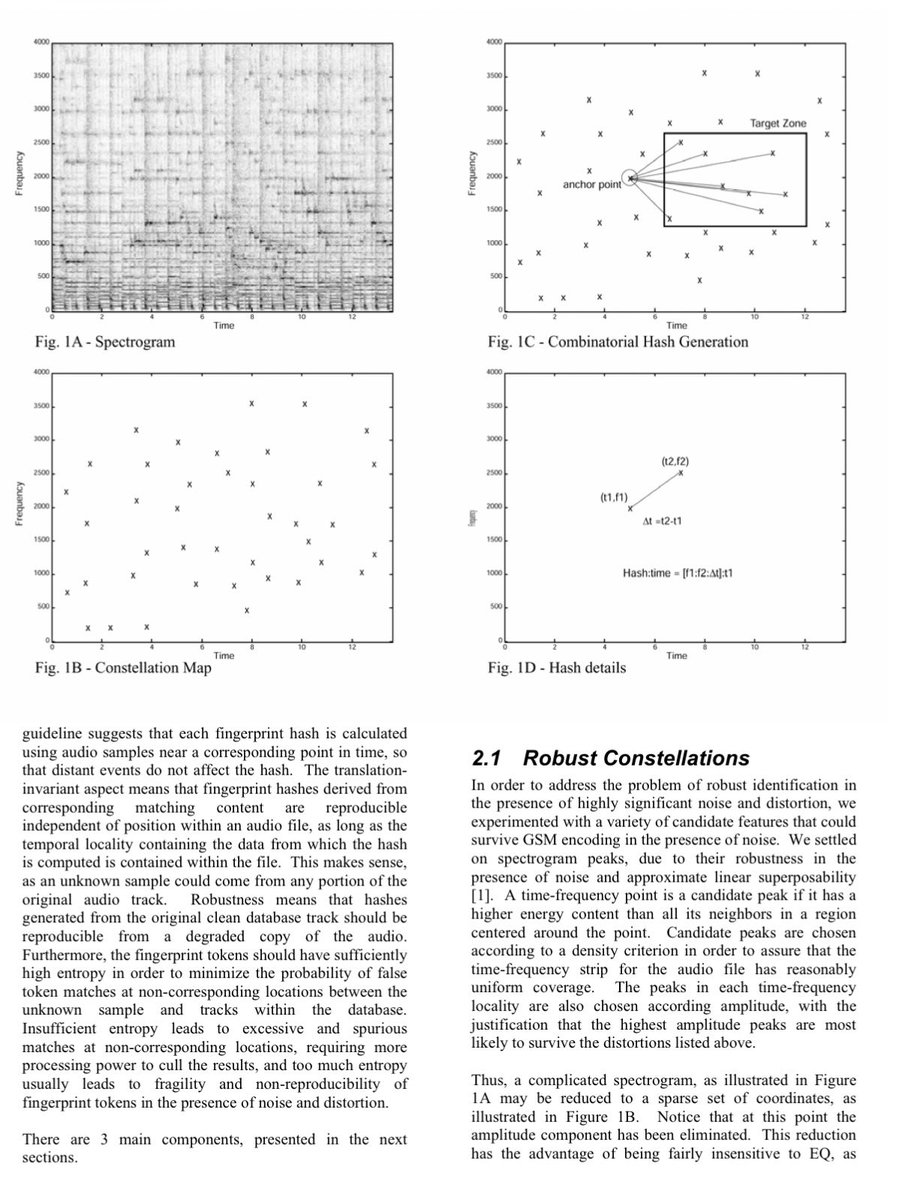
The algorithm converts audio into a spectrogram, a picture of the song, then throws almost all of it away. It keeps only the peaks, the loudest frequency points at each moment in time. Bar chatter and blown-out speakers can wreck most of a recording. The peaks survive. Shazam only ever needed the peaks.
Those surviving points form what Wang called a constellation map, because it looks like a star field. Pairs of peaks get converted into hash numbers, and identifying a song becomes a dictionary lookup rather than an audio comparison. That made it fast enough to search a million tracks on 2002 hardware.
Wang published the full method openly in 2003 in a paper called "An Industrial-Strength Audio Search Algorithm." Anyone could read exactly how the magic worked. The moat was the database and the deals with carriers, never the secret.
Apple bought the company in 2018 for a reported $400 million. People have tagged over 100 billion songs since the very first one, Jeepster by T. Rex, during the beta in April 2002.
One deterministic signal-processing trick, written before most people had heard the phrase machine learning, and it's still so good that in 2026 everyone assumes it must be AI.
Ajeya Cotra writes personally about her family's surrogacy journey, the loss of identical twin daughters at fourteen weeks, and how work and AI concerns have shaped her decisions about having children.
Nikhil Kapahi, an Amazon scientist and podcast host, distills lessons from 25 interviews with successful leaders on identity, service, luck, setbacks, and timing in careers. The essay is practical and reflective.
Shirish writes about the psychological toll of seeing a decade of learned expertise reduced to a prompt. The post is a brief reflection quoting Anthropic's announcement that Claude now works inside Google Docs, Sheets and Slides.
Claude now works inside Google Docs, Sheets, and Slides, and those files also open inside Claude.
In Google Workspace, Claude sits in a sidebar next to your file, reads what you have open, and edits it in place. You can approve each edit before it lands.
In a video clip, Palmer Luckey says he would build a startup using oxytocin to strengthen marriages and end divorce. He argues the chemical is well understood and unregulated, and that it could help couples stay together.
Palmer Luckey reveals the startup he'd build today: oxytocin doping to end divorce
"I would try to end the tragedy of divorce with oxytocin doping for marriage counseling."
"We understand mammal pair bonding pretty well. There's a lot of people who want to stay together. Most of the people who don't want to stay together should stay together, especially for their kids."
"And we can, if people think SSRIs are fine, which they're not, but if they were, then oxytocin doping to stay together is definitely fine."
"It's the mammal pair bonding chemical. There's things you can do to increase the uptake, and it's very well understood. Also, totally unregulated, which is great. Unregulated spaces are a lot easier to do. You can go buy a kilogram of oxytocin on Sigma Aldrich Chemical Supply right now, and if you do that, maybe you won't die alone."
"It's pure biology. It's used for women who don't bond with their kids, and now for women who don't bond with their husbands. It's also used for kids with various neurological issues, some kids with autism who struggle with pair bonding."
"The cool thing is it's a self-reinforcing loop. We understand that very well. Unlike most drugs, it doesn't form a chemical dependency. It actually unburdens you from a chemical dependency."
Angus summarizes Alexandr Wang's advice on getting ahead: intense focus with real time investment, going an extra mile or ten, and consistently overdelivering with purpose. The post is in Chinese and includes a video.
Ben Thompson interviews former Facebook Head of Global Elections Katie Harbath about her book Disrupting Politics and how the company changed through the 2010s.
Stratecheryby Ben Thompson··✉ newsletter · subscriber post
Subscriber post: summary only. Read the full piece at the source.
Aakash Gupta describes how New Rome, Ohio, and Macks Creek, Missouri, depended on speeding fines for most of their budgets, leading to dissolution in Ohio and bankruptcy in Missouri. Missouri subsequently capped ticket revenue at 20% of city budgets.
Ohio once dissolved an entire town because its main business was writing speeding tickets.
New Rome had 60 residents and a 14-officer police force. One cop for every four people in town. They collected around $400,000 a year in fines, 92% of the village budget, mostly by working a stretch of road where the speed limit dropped from 45 to 35.
A state audit then found the village was spending 82% of that budget on the police force. The town's only real industry was funding the thing that funded the town. In 2004 a judge ruled New Rome had effectively dissolved itself through corruption and erased it from the map. Its land got absorbed into the neighboring township.
Missouri ran the same experiment with Macks Creek, population 272, sitting on the highway to Lake of the Ozarks. The town wrote 2,900 tickets a year. Eight a day, almost all tourists who would never drive back to fight them. More than 75% of town revenue came from fines.
Then an officer there pulled over a state legislator. He went back to the capitol and passed a law capping how much of a city's budget can come from traffic tickets. Macks Creek lost its revenue stream, went bankrupt, laid off its entire police force, and disincorporated. The IRS seized the town's bank account.
Speed traps cluster wherever a highway full of out-of-towners meets a sudden limit drop in a state that lets the town keep the money. Missouri now caps ticket revenue at 20% of a city's budget. Ohio had to pass a law aimed at one specific village.
A speeding ticket heatmap doubles as a map of who's allowed to keep the fine money.
Mitchell Hashimoto argues that many highly successful people across industries are very smart, even when they present themselves as unserious, and reacts to a clip of Ben Affleck discussing his machine learning knowledge.
An uncomfortable truth for a lot of people is that a lot of the most successful people in any industry are wicked smart. We apply stereotypes based on the loudest people, but its not representative of norms. Most are crazy smart and got to where they are because of it.
I grew up in LA, one of my parents was a TV producer, my wife was an actor, many friends "in the industry." I've been constantly surrounded by it, and some of the stupidest seeming people (cause its their bit) are actually insanely smart and strategic in private. It sometimes is just beneficial for various reasons to... not show that side of you.
My favorite anecdote was when a friend (a model) was dating a phD in physics and a very rude person made some off the cuff degrading comment to model friend about it without realizing model friend has their own phD in math lol. You wouldn't know from their instagram though!
For the quoted video, I don't know Ben Affleck. I don't know how deep his knowledge goes. He's almost certainly not going to be more knowledgable than someone who professionally does this area of work full time, but he also to me on the surface sounds like someone who knows a LOT more than the average person and possibly even the average software engineer (on this topic).
Anyways, this applies to tech too. I see it constantly.
Ben Affleck reveals he writes Python, understands convolutional neural networks, worked extensively with GPUs, and used his celebrity status to get private looks at Google and OpenAI’s video models
“I’ve always been kind of into computers since I was young. Then, when film started to move from analog film to digital, I became more interested in that aspect of it. The visual-effects workflow for many years has included machine learning, so I can write pretty shitty Python scripts and stuff like that.
“With convolutional neural networks, which were the precursors to what the transformer can do…
Deedy outlines how Shazam extracts high-amplitude spectrogram peaks, hashes them with timestamp and track ID, and performs recognition via a hash table lookup. He notes that his college CS class built a version and recommends the original paper.
The serious answer to how Shazam worked is it took the peaks of a spectrogram of short clips of every song, find the peaks from the highest amplitude bits, hash it with the value being (time stamp, track id) and then the actual recognition is a hashtable lookup.
We did this for a college CS project. The original paper is fantastic:
Bret Taylor shares a celebration of Manat, who went from intern to engineer building voice products, after she demoed Tandem Voice and Persona Studio at a keynote, posing with her parents.
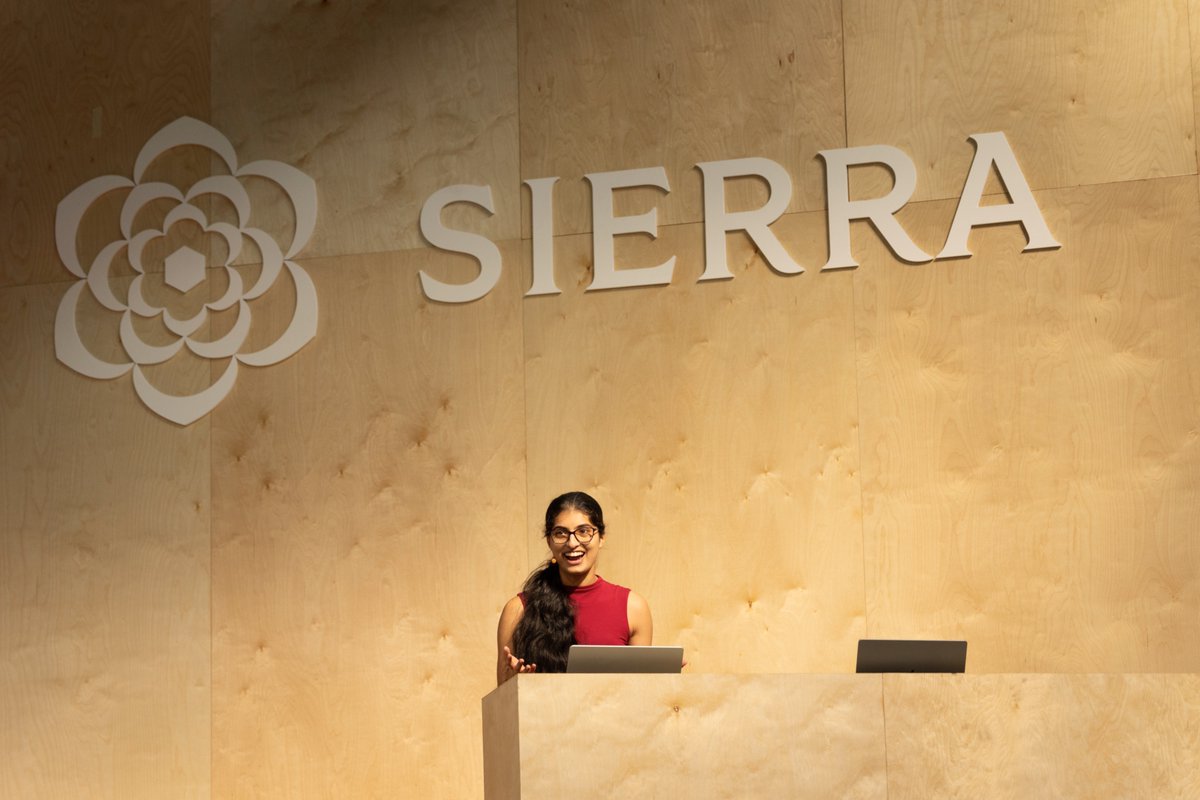
Manat started as an intern, and now she's an engineer building our voice products. She did an amazing demo of Tandem Voice and Persona Studio today. Here we are celebrating with her parents after the keynote.
Pieter Levels says he owns property in scarce coastal and mountain areas and plans to keep buying there, reflecting a thesis that people with money will move to the nicest places once AI makes work pointless. He is quoting a post by IterIntellectus making the same claim.
Aakash Gupta shares a formula for valuing private equity grants by discounting quoted equity by payout probability and years to liquidity. He compares a $400K Google grant to a $400K OpenAI grant, estimating the latter at about $242K.
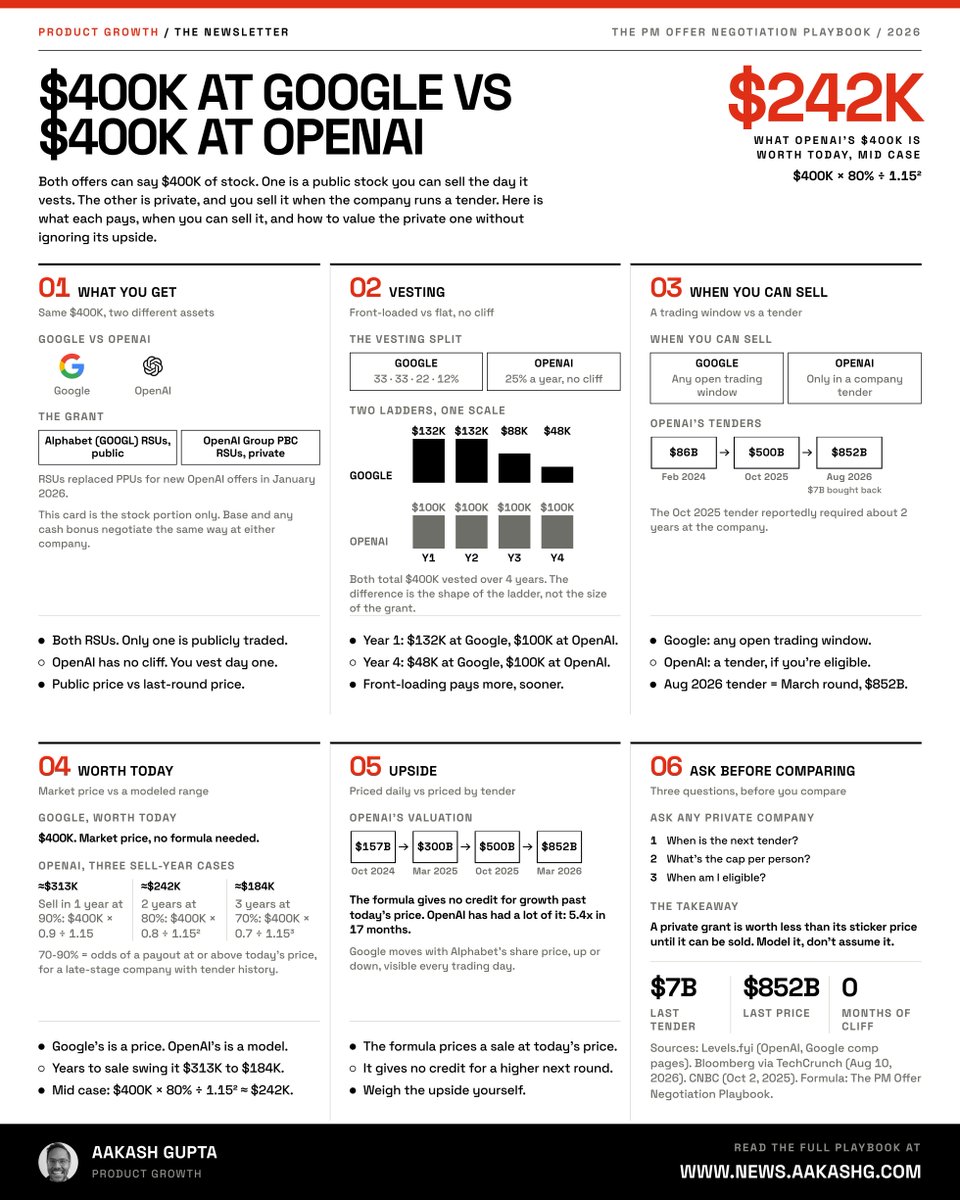
A $400K grant from OpenAI is worth about $242K today.
Same number on the offer letter. You can sell Google stock the day it vests. OpenAI is private, so you sell only when the company runs a tender.
Here's the formula I use for any private grant:
Value = Quoted equity × P(payout) ÷ 1.15^years to liquidity
The 15% is your discount for money you can't touch. For a late-stage company with real revenue and a tender history, P(payout) is 70-90%.
OpenAI, 2 years to a sale at 80% odds: $400K × 0.8 ÷ 1.15² = ~$242K. 1 year at 90%: ~$313K. 3 years at 70%: ~$184K.
Earlier stage gets brutal. A $400K grant at a Series C with an IPO 5 years out at 40% odds: $400K × 0.4 ÷ 1.15^5 = ~$80K.
The formula gives no credit for growth past today's price, and OpenAI has had a lot of it: $157B to $852B in 17 months. So treat the number as your floor.
Compare offers on what the equity is worth today. Then negotiate the gap in base and sign-on.
Yishan replies to Palmer Luckey's oxytocin remarks with a brief joke titled as reinventing hugs from first principles. The post is lighthearted commentary with no substantive claims.
Palmer Luckey reveals the startup he'd build today: oxytocin doping to end divorce
"I would try to end the tragedy of divorce with oxytocin doping for marriage counseling."
"We understand mammal pair bonding pretty well. There's a lot of people who want to stay together. Most of the people who don't want to stay together should stay together, especially for their kids."
"And we can, if people think SSRIs are fine, which they're not, but if they were, then oxytocin doping to stay together is definitely fine."
"It's the mammal pair bonding chemical. There's things you can do to increase the …
A commentary account posts a video and quote-post praising Noah Smith in a heated online argument with a commentator, and criticizes left-leaning Twitter reaction to Ezra Klein's zoning remarks. The content is personal political commentary with no technology news.
.@L0m3z sputtering, red-faced, pleading w/ Noah Smith that he's only bullying Indian kids to HELP them integrate. Noah's the wrong guy to try this kind of argument on. It’s like trying to bullshit about wine to a dog. He calls @l0m3z a Pakistani. @L0m3z is left stunned. He's been bodied. Noah Smith is not the hero we deserve, but he is the hero we need.
Noah Smith's power is his dumb guy confidence. The left is a nest of vipers waiting to pounce on anyone who expresses a positive stand on anything. Ezra Klein meekly suggests relaxing zoning rules on setbacks and lefty twitter reacts like he punched a pregnant woman in the stomach. In such an environment, it is the guileless moron who attains the status of sage. Because he just blithely says stuff. youtube.com/watch?v=x-QBwwiselI