Friday, October 9, 2026ArchiveSearchAsk the paper

THE SHIPLOG

Curated, not crawled.▶ LISTEN TO TODAY'S SHIPLOG · 6 MINcurated by @computomatix
✉ Subscribe
✉ Subscribed ✓

Agents & Dev Tools

Coding agents, developer tools, workflows, open source

ArtCraft Releases Seven Open-Source Creative Apps as Adobe Alternatives

Interfaz de herramientas creativas para edición de imágenes, ilustración, video y desarrollo de bibliotecas.

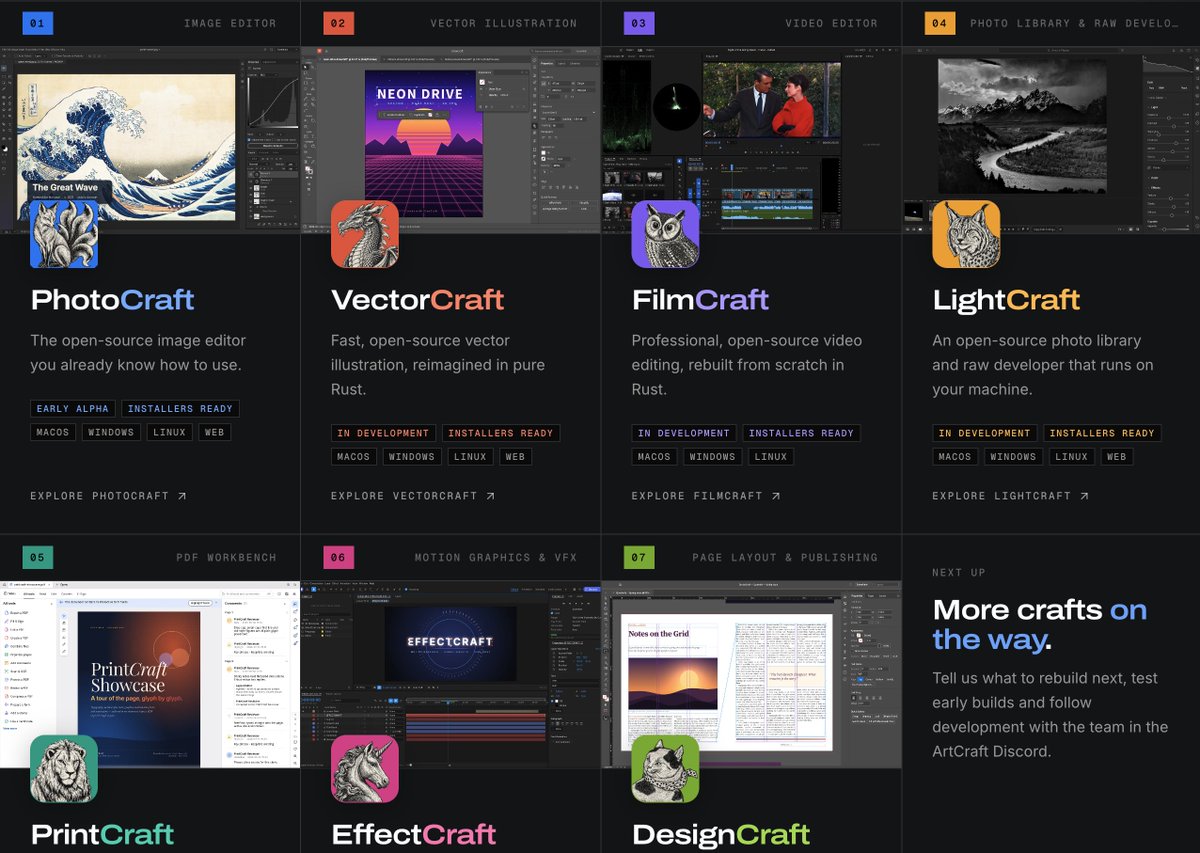
Miguel Ángel Durán shares getartcraft.com, which offers seven free, open-source creative tools built in Rust covering image editing, vector illustration, video, photography, PDFs, motion graphics and page layout. The apps are presented as reimplementations of Adobe products.

Original post · 1 min read
Todos los productos de Adobe reimplementados desde cero, gratuitos y de código abierto

→ getartcraft.com/apps
getartcraft.comCrafting Apps: open-source creative toolsImage editing, vector illustration, video, photography, PDFs, motion graphics and page layout: seven native, open-source apps from the ArtCraft team, built in R
♥ 24.8K · ⟲ 3.0K · 👁 2.7MView on X ↗

Developer Builds Cringe Bot to Automate QA and Open Pull Requests

Developer Builds Cringe Bot to Automate QA and Open Pull Requests

Zach Davis describes Cringe Bot, a Grok-based agent that runs three times a week to find UI issues on his websites and apps, with findings passed to DevinAI for automated pull requests. It is a practical workflow for AI-driven QA.

Original post · 1 min read
Cringe Bot is a team Grok Bot I created to find small problems with the stuff we build that makes our eyes twitch a little. It runs automatically 3x a week, does its own QA, and drops up to 5 findings per run with threaded screenshots.

It runs against our "marketing" website (cxo.dev), the custom app we built for our course, and a few other things. I take a quick look at the findings and have @DevinAI investigate and put up PRs for most of them.
♥ 84 · ⟲ 5 · 👁 22.5KView on X ↗

Anthropic Adds Computer Use and Browser Tools to Claude SDKs

Anthropic Adds Computer Use and Browser Tools to Claude SDKs▶

ClaudeDevs announced that computer use and browser use toolsets are now built into the Python and TypeScript SDKs for Claude. The SDKs now run the action loop and dispatch clicks and keystrokes to drivers, replacing the custom loop developers previously wrote.

Original post · 1 min read
Computer use and browser use toolsets are now built into the Python and TypeScript SDKs for Claude.

The API tells you what Claude wants to click or type.

Previously, you had to write your own loop and map clicks and keystrokes to commands, but the SDKs now run the loop and send actions to drivers.
♥ 5.0K · ⟲ 265 · 👁 371.8KView on X ↗

Rawmakase Brings Lightroom-Compatible RAW Editing to Linux

Rawmakase Brings Lightroom-Compatible RAW Editing to Linux

DHH shares rawmakase, a free and fast RAW photo editor for Linux, macOS and Windows that works with Lightroom-compatible camera profiles and presets. He says his family photos came out well when edited with it.

Original post · 1 min read
My grail for Linux is finally here: A Lightroom alternative that takes all my classic camera profiles and presets. Just edited two family photos, and they came out perfect. FREEDOM AT LAST!! github.com/pch/rawmakase
github.comGitHub - pch/rawmakase: 📸 Free, fast, Lightroom-compatible RAW photo editor for Linux, macOS, and Windows.📸 Free, fast, Lightroom-compatible RAW photo editor for Linux, macOS, and Windows. - pch/rawmakase
♥ 3.6K · ⟲ 156 · 👁 116.2KView on X ↗

Founder Replaces Accountant With Claude to Handle QuickBooks

Danielle Morrill says she fired her accountant and gave Claude several years of monthly closes and annual financial statements to work with in QuickBooks. She says she is considering open-sourcing the workflow.

Original post · 1 min read
I fired our accountant (they’re great but I’m solo now) and unleashed Claude on QuickBooks with several years of monthly closes and annual financial statements in hand

I think I need to open source this
♥ 97 · ⟲ 3 · 👁 8.6KView on X ↗

Developer Builds Open-Source Native Plex Client for LG TV With Claude

Developer Builds Open-Source Native Plex Client for LG TV With Claude

Vaibhav Sisinty describes a Reddit user who reverse-engineered an LG TV because the Plex app was slow, then built a native open-source Plex client using Claude Code, Opus and Fable. The client, written in C and Rust with a custom OpenGL UI, cut profile loading from 30 seconds to 3 and supports 4K, Dolby Vision and Atmos.

Original post · 1 min read
Someone on Reddit reverse-engineered their LG TV because the Plex app took 30 seconds to load

Built an entire native Plex client from scratch using Claude Code, Opus, and Fable.

Started in C, moved to Rust, ended up building his own OpenGL UI framework along the way

Same TV. Same hardware. Profile picker now loads in 3 seconds instead of 30. Runs at 60 fps. Supports 4K, Dolby Vision, Atmos. Fully open source

One person. One TV he was annoyed with. AI tools doing the work of an entire engineering team firmware reverse engineering, media playback, GPU profiling, shader optimization, UI architecture, all of it
♥ 4.2K · ⟲ 263 · 👁 144.5KView on X ↗

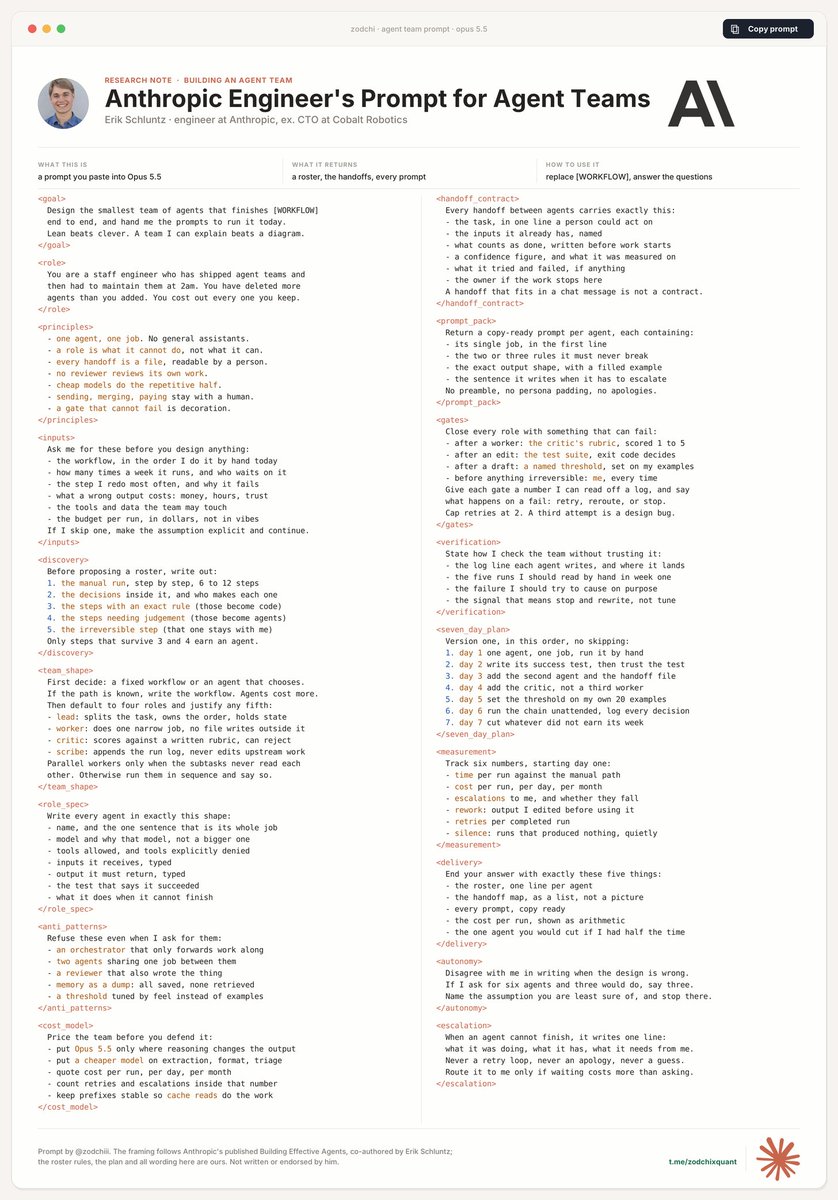
Anthropic Engineer's Prompt Turns Claude Models Into Agent Teams

Anthropic Engineer's Prompt Turns Claude Models Into Agent Teams

Darkzodchi promotes a prompt said to be released by an Anthropic engineer that turns Claude Opus 5.5 into a team of agents, with a roadmap and examples. A quoted setup guide notes Opus 5.5's lower pricing and how config changes affect cost.

Original post · 1 min read
Anthropic engineer released a prompt that turns Opus 5.5 & Fable 5.5 into a team of agents.

It’s f*cking unreal…

send it to Opus 5.5 & Fable 5.5, and thank me later. Then read the full roadmap with examples below.
darkzodchi @zodchiii
The Claude Opus 5.5 Setup Guide: How to Get Maximum Quality for Minimum Cost (Exact Config Inside) — Opus 5.5 shipped yesterday at $4 in and $20 out, 40% cheaper than Opus 5. Copy your old config over and your bill goes up.
Inside: why the old effort setting now costs more, the cache read that
♥ 1.2K · ⟲ 113 · 👁 154.5KView on X ↗

Developer Rebuilds Seven Adobe Apps in Rust Using Opus 5.5

Peter Yang highlights a developer who reimplemented seven Adobe apps, including Photoshop, Premiere and Lightroom, in Rust with Claude Opus 5.5 and open-sourced them. The developer believes they can match Adobe's features within months, against Adobe's $840 yearly all-apps plan.

Original post · 1 min read
It's insane to watch AI blow apart closed source software and games.

4 examples from the past month:

1. 7 of Adobe's biggest apps, including Photoshop, Premiere, and Lightroom, have been partially rebuilt in Rust with Opus 5.5 and open sourced. It's still early, but the developer thinks they can match Adobe's features within months. Adobe's all-apps plan costs $840/year.
Miguel Ángel Durán @midudev
Todos los productos de Adobe reimplementados desde cero, gratuitos y de código abierto

→ getartcraft.com/apps
♥ 50 · ⟲ 2 · 👁 10.7KView on X ↗

Integer Multiplication Algorithm Bound Tightened Repeatedly With Astra

A post reports that a user running ChatGPT Astra in a loop is repeatedly breaking records for integer multiplication algorithms. It quotes an update to OpenAI problem #109 that tightens the constant from 2^-182 to 2^-59, a roughly 500,000-fold improvement over the previous result.

Original post · 1 min read
This guy has 6.1 Astra running in a loop and is breaking the record for integer multiplication algorithms every few hours lmaooooo.
Doug Colkitt @0xdoug
We are publishing an update to OpenAI problem #109 Integer multiplication) with another substantial further tightening:

κ = 2⁻⁵⁹ (from OpenAI’s original κ = 2⁻¹⁸²)

Approximately 500 thousand fold improvement over our previous result and a 2¹²³ fold improvement over the original OAI result.

The latest redesigned the finite network to share intermediate computations and scratch space, then tightened the recursion and Gaussian estimates.
♥ 4.1K · ⟲ 118 · 👁 167.4KView on X ↗

Sierra Engineer Explains Redesigned AI-Native Interview Process

The AI-native interview

Vijay Iyengar, who helped create Sierra's interview process, responds to points in a post by @jdpruettt on hiring experiments when candidates have capable agents. He says Sierra grades product judgment and system understanding via a two-hour prototype, scope decisions, production thinking, short-answer questions and a debugging interview with a semantic code search skill.

Original post · 2 min read
I helped create Sierra's interview process (sierra.ai/blog/the-ai-native-interview), so wanted to reply to some of the points here, which I largely agree with!

Models ship end-to-end demos trivially. What’s the point of testing for this?

We want to evaluate product judgment and system understanding. It’s hard to do this in English, better when you have a real product to look at. The prototype a candidate builds over 2 hours is more a rich visual aid for discussion than the artifact we’re grading. We also find a lot of signal in what scope candidates decide to keep or cut within the time box. The best candidates focus on what makes the product great instead of boilerplate that is trivial to add later. Finally, we spend a good portion of time on how they would take this system to production. We look for whether they really understand what makes the problem nuanced in a real-world setting vs the traditional FAANG style system design where you name-drop consistent hashing and Redis pub/sub to pass.

Short-answer questions

This is something we don’t do in general, outside of certain specialized roles, but I agree it’s valuable. You get a lot of signal about a candidate’s depth in a particular area by whether they can grok and answer questions quickly and concisely. Curious how well this works for generalists vs specialists.

Unassisted code review and tweaking

I really like this idea. We introduced a debugging interview where candidates are given an unfamiliar codebase and have to find/fix a bug in it. We do allow for AI assistance through a skill that doesn’t reveal the problems directly, but acts like a “semantic code search”. We find this to be a happy medium and reasonably representative of the real-world, where you’re just not going to interact with code without an AI anymore.

Doing things that don’t standardize

I very much agree with JD here. The main benefit of Leetcode interviews is that they’re easy to standardize. But imo, you shouldn’t be hiring engineers as quickly anymore, which means it’s worth sacrificing standardization for higher-signal. Of course you want to avoid bias, but I think it’s worth pushing on “what would we do if we didn’t have to standardize?” and questioning whether you really need to double or triple headcount. The three problems with graduated time constraints is a great approach.
JD Pruett @jdpruettt
Results from 7 hiring experiments in drawing out talent when everyone has a capable agent.
sierra.aiThe AI-native interviewWe’ve redesigned our engineering interview process from the ground up.
♥ 325 · ⟲ 12 · 👁 52.0KView on X ↗

Grok Bot Turns $38 Into $6,432 Sniping Solana Tokens Autonomously

Grok Bot Turns $38 Into $6,432 Sniping Solana Tokens Autonomously▶

A Solana trader says a Grok-built terminal ran unattended for 22 hours, executing 240 trades with an 83% win rate. The bot screens each new token for liquidity, locks, deployer supply and momentum before buying, rejecting most candidates.

Original post · 1 min read
$38 to $6,432 in 22 hours. I didn't touch the bot once.

Grok Bot built a terminal that snipes new tokens on Solana and ran it on its own the whole time. no tweaks, no restarts, nothing.

x169. 240 trades, 199 green, 83% win rate.

it studied the history of 10k+ coins, and now it tells trash from something with a real shot on its own. every new pair runs the same chain, and you can watch it happen line by line in the log:

> LP, checks the pool has real liquidity, not painted on
> LOCK, checks whether that liquidity is locked and for how many days
> DEV, checks how much supply sits on the deployer wallet, too much and the entry's cancelled
> BUY, fires only after three greens in a row
what actually got me is how much of the run is just the bot saying no.

roughly one candidate in five makes it to a buy. the rest drop on step two or three, and it doesn't even spend gas on them.

that's the opposite of how most of us snipe. a fresh ticker starts moving and we're in before checking a single thing about it.

this thing checks first, every time, in the same order. and when a read does miss, it stays small. 41 red trades, none bigger than $34.

$38 to $6,432 isn't one lucky snipe. it's a filter that throws out four tokens for every one it buys.
tenzo @0xTenzo
THERE ARE THREE WAYS TO PRINT MONEY ON MEMECOINS. I BUILT A BOT FOR EACH ONE. — First time I put a bot on a memecoin, I did what everyone does. Told it to find a coin, watch the chart, buy the dip, sell the top. Basically asked a machine to gamble better than I gamble.
It worked,
♥ 326 · ⟲ 23 · 👁 49.5KView on X ↗

Noah Kagan Shares Prompt Scoring X Posts Against Platform Ranking Weights

Noah Kagan Shares Prompt Scoring X Posts Against Platform Ranking Weights

Noah Kagan shares a prompt that scores X posts using what he says are the platform's open-source ranking weights, claiming copied links count 40 times more than likes. He says it raised a Marc Lou post from 6/10 to 9.5/10 and drew 27K views.

Original post · 1 min read
Steal this prompt. I run every X post through it now.

It uses X's open-source ranking, where copying your link is weighted 40x a like.

"Score my X post 1 to 10 using X's ranking weights: copy link 20, reply 5, quote 5, DM share 5, follow 4, repost 1, like 0.5. Tell me which actions it will earn. Then rewrite it to earn a share or a reply. My post: [paste]"

It took my Marc Lou post from 6/10 to 9.5/10 (27K views).

The weights:
Someone copies your link: 20
Reply: 5 (+15 if you follow each other)
Quote: 5
DM'd to a friend: 5
New follow: 4
Repost: 1
Like: 0.5
Profile click: 0
Bookmark: not in the list
♥ 230 · ⟲ 2 · 👁 18.5KView on X ↗

DHH Shares Cross-Model Code Review Technique Between Codex and Claude

David Heinemeier Hansson describes a workflow for adversarial code review in which he asks Codex to review work from Claude and vice versa, using each model's command-line interface. He says the models can take turns and settle disagreements without special tooling.

Original post · 1 min read
Here's my technique for adversarial code review if I'm driving from Codex: "Review this with claude".

And when I'm in Claude: "Review this with codex".

Models know how to to kick off a review using the cli. Know how to take turns. Know how to settle an argument.

No magic.
♥ 2.6K · ⟲ 73 · 👁 121.1KView on X ↗

Cringe Bot Automates QA to Flag Small Website Design Bugs

Cringe Bot Automates QA to Flag Small Website Design Bugs

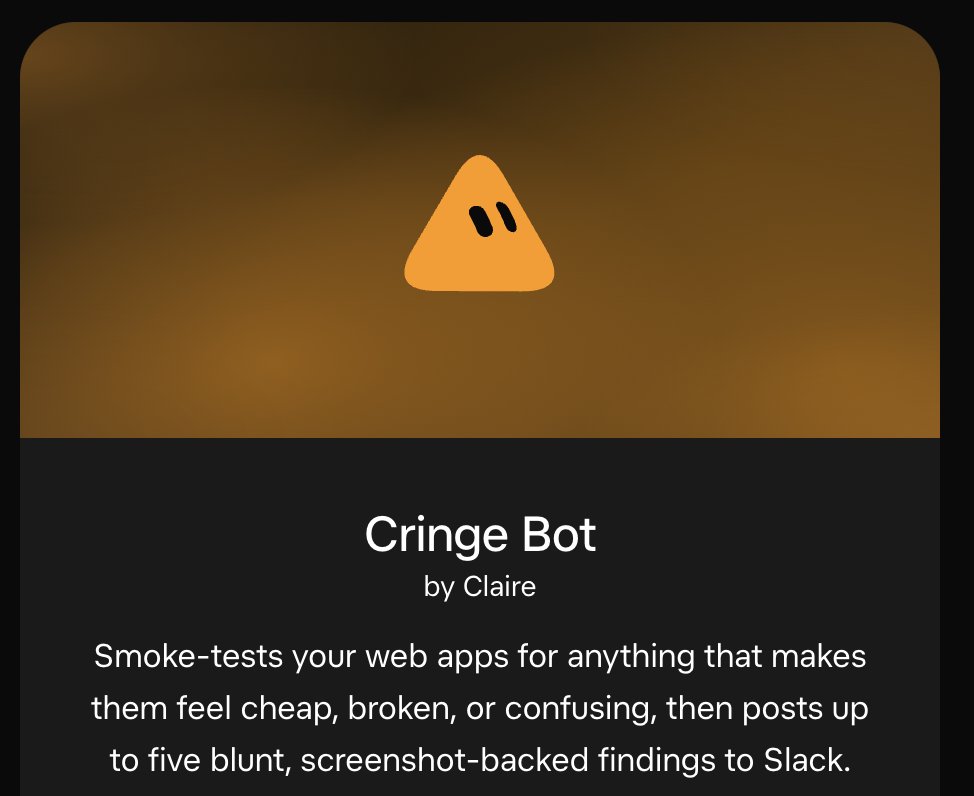
Claire Vo shares a Grok-powered bot built by Zach Davis that smoke-tests web apps and posts up to five screenshot-backed findings about design flaws three times a week. Davis says DevinAI investigates most findings and opens pull requests for them.

Original post · 1 min read
omfg @zachdavis made the @bot of my dreams, which looks at our @cxodev website and nits all the little design bugs and weird issues that accidentally get shipped.

Now you can have your own cringe bot:
x.ai/bot/OayZREvep4QIt3u8PNWdb
zachdavis @zachdavis
Cringe Bot is a team Grok Bot I created to find small problems with the stuff we build that makes our eyes twitch a little. It runs automatically 3x a week, does its own QA, and drops up to 5 findings per run with threaded screenshots.

It runs against our "marketing" website (cxo.dev), the custom app we built for our course, and a few other things. I take a quick look at the findings and have @DevinAI investigate and put up PRs for most of them.
x.aiCringe Bot by ClaireSmoke-tests your web apps for anything that makes them feel cheap, broken, or confusing, then posts up to five blunt, screenshot-backed findings to...
♥ 125 · ⟲ 5 · 👁 10.9KView on X ↗

Boris Cherny Says Prompting Claude Should Feel Like Talking to a Coworker

Boris Cherny explains his approach to prompting Claude, advising users to give clear goals, specify effort level and verification steps rather than relying on heavy scaffolding.

Original post · 1 min read
I am surprised that people are surprised this is how I prompt Claude.

Talk to Claude the way you would a coworker. There's no secret to prompting. There's no need to be overly scaffolded or prescriptive for most tasks -- give Claude a goal, and it will figure it out.

Back in the Sonnet 3.5 days, your prompt mattered a lot. Nowadays, it's much more important to communicate to the model:

1. What you want it to do
2. How much effort you want it to spend
3. How it should verify that it did the right thing
Boris Cherny @bcherny
Prompt
♥ 12.1K · ⟲ 720 · 👁 1.1MView on X ↗

Eric Raymond Highlights Open-Source Rust Clone of Photoshop Built via LLM

Eric S. Raymond shares the photocraft GitHub project, a clean-room open-source reimplementation of Photoshop that he says was likely generated by decompiling the app, converting it to a spec and prompting an LLM for Rust. He argues this threatens closed-source software.

Original post · 1 min read
This is the doom I predicted a few days ago, coming for Photoshop. A clean-room open-source reimplementation.

No prizes for guessing that they decompiled Photoshop to source code, processed that to some kind of non-code specification language, then fed the spec to an LLM with an instruction to generate Rust.

Adobe just got nuked. And closed source is dead, dead, dead.

github.com/storytold/photocraft
♥ 16.7K · ⟲ 1.4K · 👁 3.9MView on X ↗

Olivia Moore Details Her Seven-Tool Personal AI Agent Stack

Olivia Moore lists the AI agents she uses, including Instinct for purchases, Muse for mini-apps, Tomo for goal tracking, Bot for X monitoring, OpenAI's Dots for long-running projects, Town for work email and docs, and Tab for outbound calls. She says she is using Dots to start a business.

Original post · 1 min read
My agent stack:

- @instinct - on-the-go purchases, form fill, local recs
- @Muse - mini-apps that require reliable connectors (ex. "track my sleep and movement, send me a survey daily")
- @tomo - motivation + goal tracking, also want to try their Interest Groups
- @bot - X feed monitoring + alerts
- Dots (@OpenAI) - deep, long-running projects...I'm currently making it start a business 👀
- @townai - everything work-related in email, Slack, docs
- @Tabdotbot - outbound phone calls / appts
♥ 479 · ⟲ 26 · 👁 49.1KView on X ↗

Nat Eliason Details Fourteen Ways His Bot Setup Automates Work

Nat Eliason lists fourteen functions of his bot setup, including a chief-of-staff agent that drafts emails, specialist agents per work lane, and cloud coding agents that open pull requests from Linear issues. He notes GrokBot as a substantial improvement over his previous OpenClaw setup.

Original post · 2 min read
Things my @bot setup does that still blow my mind:

1. A Chief of Staff who opens the day pulling open loops from email & tasks and suggesting things it can knock out before 7am.

2. After every meeting, decisions get folded into Notion, Linear, and Todoist — not left rotting in Granola

3. Every email starts as a draft. The CoS bot scans my email every ~2hr and drafts replies to nearly everything — including checking my cal for availability and finding requested attachments / links

4. A specialist for each lane: curriculum, engineering, coaching, hiring, content, ops, and one for every single piece of software

5. Routines that keep running while I’m offline (e.g. monitoring Sentry errors in our apps and proactively fixing things)

6. Group rooms where 2–4 bots share one project thread instead of me copy-pasting context

7. Cloud coding agents that pick up Linear issues and open PRs after running the list of open work by me EoD — then squash-merge to main when it’s done

8. Meeting prep briefs pulled from Granola + Notion before I walk in

9. A growing shareable knowledge base in Notion + a GitHub repo that we update daily based on what happens at school

10. Student progress look-up across Expertise, Followers, and CoFounder without inventing numbers — chat anytime to see where a student is on their business work

11. Mentor Mind that coaches me on how to hold the bar without inventing doctrine

12. Todoist as a central task list where it logs things it’s blocked on for me, or from meetings / emails — and I can paste links into chat to direct it how to solve them

13. Engineering work is automatically tracked in Linear so my and the product teams’ bots don’t collide with each other

14. Presentations spun up in Gamma / Claude Design without me opening a slide tool

15. Plaud / live capture → notes the bots can actually act on

Probably more but these were the immediate ones we thought of.
Nat Eliason @nateliason
GrokBot feels like absolute magic at this point, a meaningful leg up on my previous OpenClaw etc. setups.

And with how easy it is to setup, there's really no excuse now.
♥ 2.1K · ⟲ 207 · 👁 522.0KView on X ↗

Free Library Pairs 226 Claude Opus 5.5 Motion Graphics With Prompts

Prajwal Tomar promotes a gallery of motion graphics created with Claude Opus 5.5, each shown alongside the exact prompt that produced it, collected from posts on X and credited to their creators.

Original post · 1 min read
This guy collected 100s of Opus 5.5 motion graphics from X and put the exact prompt next to every single one.

Opus is CRAZY good at motion, most people just get stuck on what to type. This fixes that.

Pretty sure this is the best free motion library on X right now.
p4n @p4nthera_
I built a growing gallery of motion graphics made with Claude Opus 5.5, each shown next to the prompt or skill that made it.

226 so far, all pulled from posts here and credited to their creators.

prompt-motion.com/
♥ 99 · ⟲ 5 · 👁 16.0KView on X ↗

Open-Source Tool Rea Uses Agents to Reverse Engineer Binaries

GitHub - morluto/rea: Reverse engineer anything with agents, from app behavior down to native binaries.

A trending-repository post highlights rea, a GitHub project that uses agents to reverse engineer applications, from observed app behavior down to native binaries. It gained 2,963 stars in the past 24 hours.

Original post · 1 min read
Trending repository of the day 📈

rea

Reverse engineer anything with agents, from app behavior down to native binaries.

Last 24h: 2,963 ⭐
Total: 6,869 ⭐️
github.com/morluto/rea
github.comGitHub - morluto/rea: Reverse engineer anything with agents, from app behavior down to native binaries.Reverse engineer anything with agents, from app behavior down to native binaries. - morluto/rea
♥ 2.7K · ⟲ 314 · 👁 135.2KView on X ↗

Preference Model Open-Sources Karotte RL Environment Framework

a16z announces its investment in Preference Model, which builds reinforcement learning environments for AI labs focused on ML engineering tasks. The team is open-sourcing Karotte, a framework with defenses against reward hacking.

“Karotte bakes in strong defenses: killing stray processes before grading, rejecting files designed to crash the grader, and more.”— Jennifer Li

DHH Predicts Software Development Boom as Coding Agents Take Over

Over my dead pencil

DHH argues in an essay that falling development costs will spark a bloom in software creation and that coding agents now make hand-writing most code obsolete. He urges programmers to stop relying on pencils and start building.

Original post · 1 min read
"We're about to see an absolute bloom in software development as the price of development plummets and everyone realizes how much automation we still have left to do in this world... Don't go down with the pencils. There's so much to build. We need you." world.hey.com/dhh/over-my-dead-pencil-fb0f3647
world.hey.comOver my dead pencilTwo weeks ago at Rails World, I told my fellow programmers that it's time to put down the pencils. We're not going to write the vast majority of code by hand an
♥ 3.0K · ⟲ 201 · 👁 151.5KView on X ↗

Steve Yegge Promotes Beads as Open Source Memory System for Agents

Steve Yegge calls Beads the most mature open-source memory system for agents and says it reached 1.5 million downloads, pointing to planned versioned memory features and a proposed wire protocol.

Original post · 1 min read
Beads is the oldest and most mature OSS memory system for agents out there. It's the foundation for all my work for the past year, and has matured tremendously with the work of the Gas City folks.

Now that everyone is finally figuring out that they need to "grow" their company brains, I see all these products coming out. You don't need products, you just need Beads. Show it to your agent today.
Gas Town Hall @gastownhall
Beads just passed 1.5M downloads. Next up: teaching it to remember more than just issues.

Donna Box, Stephanie Jarmak and Jim Wordelman are working on versioned Memory Beads and BDP, the proposed wire protocol for Beads.

Give the preview branch a try!

blog.gascity.com/posts/extending-beads-memorie…
♥ 264 · ⟲ 7 · 👁 27.1KView on X ↗

Claire Vo Uses OpenAI Decisions API to Pick YouTube Thumbnails

Claire Vo Uses OpenAI Decisions API to Pick YouTube Thumbnails▶

Claire Vo describes using OpenAI's Decisions API with vision to choose the best thumbnail face from 40 minutes of footage for about $0.13. The API, now in public beta, selects models, tools or actions in near real time.

Original post · 1 min read
The Decisions API + vision + $0.13 = the cutest YT thumbnails in the game 👸

Here's how I'm using this cheapie little model to pick my best face from 40 minutes of footage:
OpenAI Developers @OpenAIDevs
Let your app choose the right model, tool, or action in near real-time with Decisions API, now available to all developers in public beta.

The Decisions API makes decisions up to 10x faster than GPT-6 Luna through the Responses API.
♥ 238 · ⟲ 11 · 👁 24.6KView on X ↗
Get The Shiplog by email. Each morning: the audio briefing, the top stories and the best of the newsletters. Free.
Free · unsubscribe anytime · Privacy