NYU math professor Tristan Buckmaster says a Tuesday release of 722 AI-generated math papers from OpenAI wiped out entire research programs and damaged early-career mathematicians' careers. The claim is made in a video clip.
Amock_ praises Sabeer Bhatia for posting about a documentary and calls the film remarkable. Bhatia's quoted post invites followers to join him in watching the film together. The post includes a video.
Andrew Curran reports that a CrowdStrike report suggests a single person may have carried out a cyberattack on major South Korean banks using a stack of open-source and commercial AI tools, including Claude Code and Grok. The claims are as relayed in the post.
Last week some of South Korea's biggest banks were hit by a cyberattack. Thanks to a report from CrowdStrike tonight, we now know the entire hack may have been done by a single person. He used a combined stack of an open-source AI penetration tool named ARTEX, DeepSeek v4.1-Flash, GLM-5.3, Grok 4.6, and Claude Code.
Arun Golaya explains that GPS is a passive system and that civilian signals remained globally available during Kargil, subject only to the worldwide Selective Availability degradation. He argues that India was not selectively denied GPS and that military-grade P(Y) code was unavailable due to US sanctions.
Another myth just like the story about the US denying GPS to India during Op Vijay (Kargil).
GPS is a purely passive system. It works on pseudo ranging. The receivers receive data from multiple satellites (4 satellites for resolving 3D position and time) and work out their own position. No transmission by the user is needed.
Another statement I have read many times (including in some reputed defence journals) is that the US “denied” GPS to India during Kargil thus making us initiate the case for NAVIC. I’m not sure how this story came about.
Non military (US / NATO) GPS sets (till May 2000) operated under the US Selective Availability (SA) policy, which deliberately degraded civilian accuracy *worldwide* to roughly 100 meters horizontal (versus the much higher military precision). India was not uniquely singled out. SA was a standing global feature of GPS (including for US based civilian users) from the early 1990s until President Clinton ordered it turned off in May 2000.
Even during Kargil, civilian GPS signals remained available globally. Indian forces too used commercial/handheld GPS receivers (including units fitted into some aircraft).
I’m not sure if India ever asked for the precision code for targeting during Op Vijay. It is highly unlikely as at that time, India was under US sanctions (after India’s 1998 nuclear tests. Under the Glenn Amendment), which restricted military sales, equipment and technical assistance to India. So at best, Military-grade GPS (encrypted Precise Positioning Service / P(Y) code) was not provided to India. I’m not sure how the stories about GPS being “denied” to India came about. Selectively denying GPS to a particular user / group of users is also not technically feasible. It can be denied (by the US) or even jammed / spoofed (by anyone not just the US) with the right equipment *over an area*…but that again cannot be country specific.
Elon Musk says Starlink is licensed in more than 165 countries and has complied with Indian requirements for five years, asking why it still lacks a license. He suggests Mukesh Ambani has outsized influence over the government, quoting a post alleging crony capitalism.
Starlink is licensed in over 165 countries and has spent five years complying with every single law and requirement of the government of India, so why still no license?
Zach Davis describes Cringe Bot, a Grok-based agent that runs three times a week to find UI issues on his websites and apps, with findings passed to DevinAI for automated pull requests. It is a practical workflow for AI-driven QA.
Cringe Bot is a team Grok Bot I created to find small problems with the stuff we build that makes our eyes twitch a little. It runs automatically 3x a week, does its own QA, and drops up to 5 findings per run with threaded screenshots.
It runs against our "marketing" website (cxo.dev), the custom app we built for our course, and a few other things. I take a quick look at the findings and have @DevinAI investigate and put up PRs for most of them.
Anjney Midha announces hundreds of MI355x and B300 nodes are live on nationalcompute.com, subsidized for .edu and .gov users. The site describes a public-sector compute access program with a capacity tracker.
Vladimir Bayandin promotes Explee, an AI outreach agent that identifies ideal customers from a website link, writes personalized emails, books calls and handles follow-ups. He offers a $30 free trial.
Danielle Morrill says she fired her accountant and gave Claude several years of monthly closes and annual financial statements to work with in QuickBooks. She says she is considering open-sourcing the workflow.
I fired our accountant (they’re great but I’m solo now) and unleashed Claude on QuickBooks with several years of monthly closes and annual financial statements in hand
Aswath Damodaran links to a blog post analyzing how trillions in AI capital expenditure affect book capital, earnings and cash flows across company financial statements. He argues the spending is distorting market valuation metrics.
As companies have invested trillions into AI cap ex, driven by the hope of riches, it is not just markets that have been roiled. I look at how the spending has percolated through financial statements distorting book capital, earnings and cash flows. aswathdamodaran.blogspot.com/2026/10/stock-pri…
Patterns reports that the Indian stock market added ₹18 lakh crore in a single day, its biggest one-day gain in at least five years. The post includes a photo.
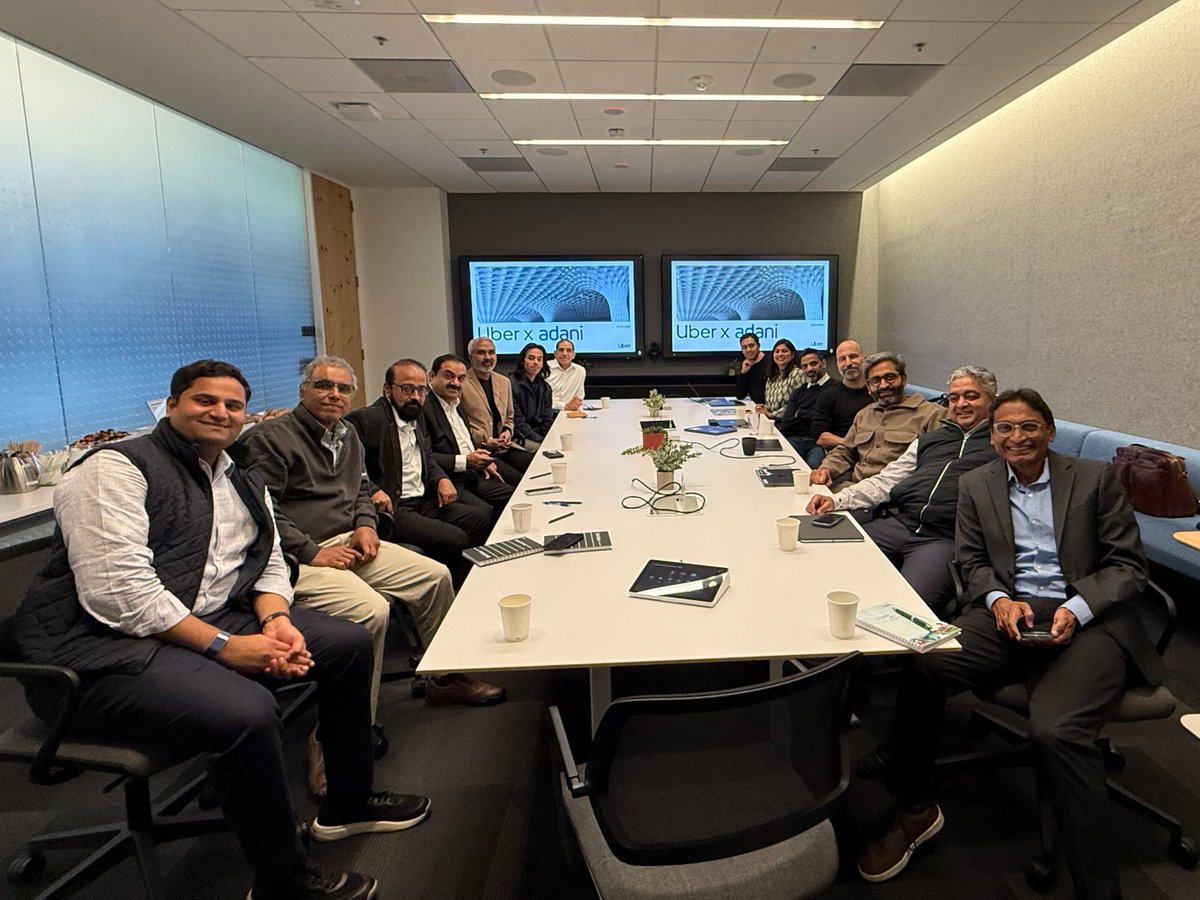
Uber CEO Dara Khosrowshahi says he hosted Adani Group leaders Gautam and Jeet Adani at Uber. He notes Uber's partnership with seven Adani airports, including Navi Mumbai, and says the parties discussed AI, autonomous vehicles and the airport experience in India.
Great to host @gautam_adani, @jeet_adani1 from @AdaniOnline at @Uber. We’re partnered at 7 Adani airports, incl Navi Mumbai, that handle a quarter of India's air traffic. We talked about what’s next: AI, AVs + an even better airport experience for travelers across India, one of the world’s most exciting markets.
DHH shares rawmakase, a free and fast RAW photo editor for Linux, macOS and Windows that works with Lightroom-compatible camera profiles and presets. He says his family photos came out well when edited with it.
My grail for Linux is finally here: A Lightroom alternative that takes all my classic camera profiles and presets. Just edited two family photos, and they came out perfect. FREEDOM AT LAST!! github.com/pch/rawmakase
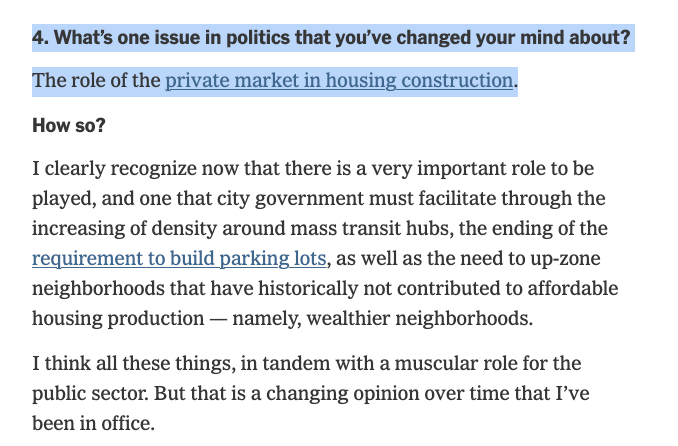
Matthew Zeitlin shares a New York Times interview in which Zohran Mamdani says he has changed his mind about the role of the private market in housing construction. The post quotes a developer touting market-rate projects in democratic socialist districts.
Private developers are essentially bragging about still being able to do market-rate development in districts represented by democratic socialists therealdeal.com/new-york/2026/08/07/nyc-commie…
Aviator Anil Chopra shares an Inshorts report claiming Iranian fighter pilots bombed US bases without GPS, relying on paper maps. The post links to the news summary and includes a photo.
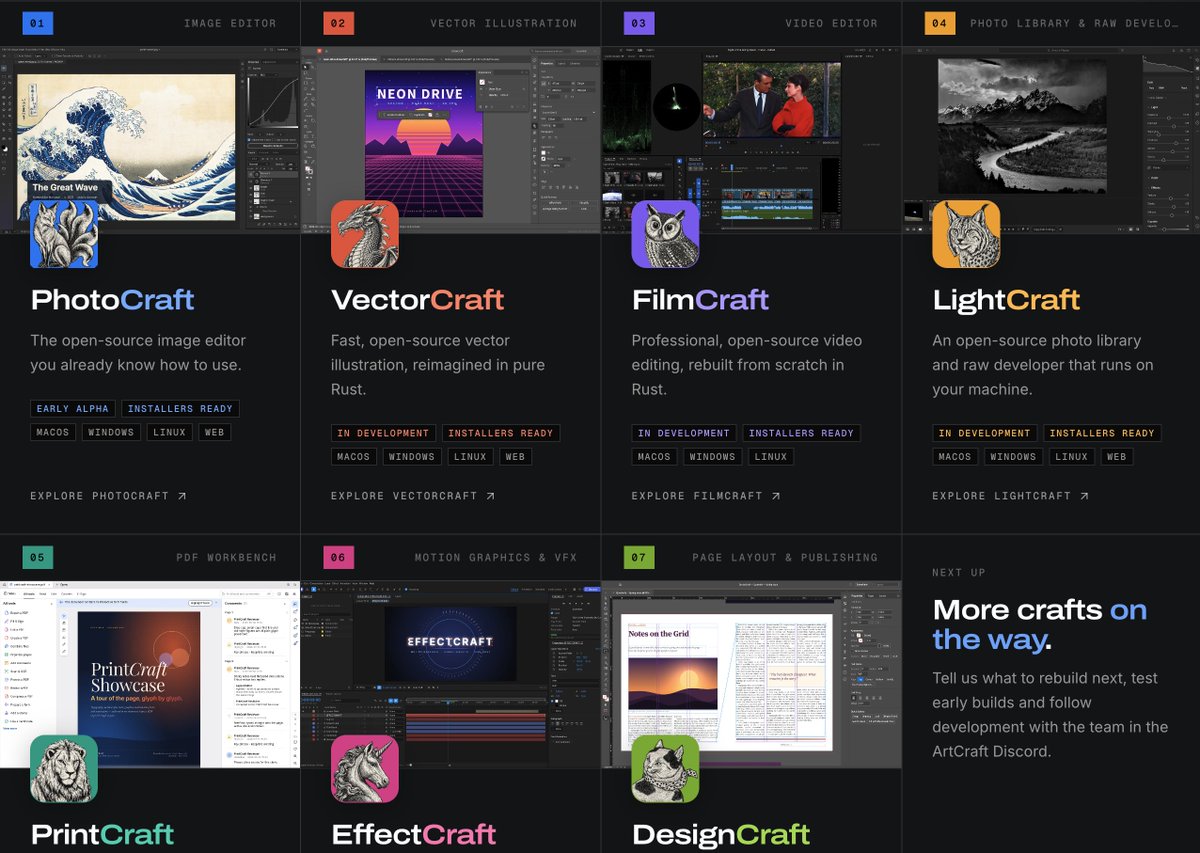
Miguel Ángel Durán shares getartcraft.com, which offers seven free, open-source creative tools built in Rust covering image editing, vector illustration, video, photography, PDFs, motion graphics and page layout. The apps are presented as reimplementations of Adobe products.
Aakash Gupta recounts how screenwriter Adele Lim left the Crazy Rich Asians sequel after a pay dispute, stalling the franchise for years. He notes she now serves as HBO series showrunner through her company 100 Tigers, with the cast and Jon M. Chu returning.
The sequel to a $239 million movie fell apart over a $110,000 offer. And the writer who walked away just got handed the entire franchise.
Crazy Rich Asians cost Warner Bros $30 million in 2018 and grossed $239 million worldwide. First studio film with an all-Asian cast since The Joy Luck Club in 1993. A sequel should have been greenlit before opening weekend ended.
Instead the franchise went dark for seven years.
The unraveling started with the pay offers. Co-writer Peter Chiarelli, the veteran who wrote The Proposal, was offered $800,000 to $1 million for the sequel. Adele Lim, the writer Jon M. Chu brought in to give the script its cultural voice, was offered around $110,000. Chiarelli offered to split his own fee with her. She turned it down, said what she makes shouldn't depend on the generosity of the white-guy writer, and quit.
Warner Bros came back months later with an offer near parity. She passed on that too.
Without her, the sequel never recovered. Chu left to make In the Heights and then Wicked. Two separate sequel attempts collapsed. The most bankable rom-com of its decade produced nothing for most of a decade.
Now look at the structure of what got announced. The HBO series runs through Lim's own production company, 100 Tigers, with Lim as showrunner, writer, and executive producer. Chu and Kevin Kwan are EPs on her show. Constance Wu, Henry Golding, and Michelle Yeoh are all back.
In 2019 the studio wouldn't match her co-writer's $800,000. In 2027 the same studio is putting the whole franchise in her hands.
Walking away from the biggest credit of her career looked like a terrible move for a first-time feature writer. It turned out to be the trade that got her everything.
From Jon M. Chu and Adele Lim, #CrazyRichAsians will continue as an HBO Original Series starting production in 2027. Constance Wu, Henry Golding, Ronny Chieng, and Michelle Yeoh reprise their roles based on Kevin Kwan's bestselling books.
JM US argues that the Indian stock market gained close to $200 billion after the H-1B announcement, with most gains in Indian IT firms. He contends restricting H-1B visas benefits India and that talent shortages push American firms to offshore work.
Indian stock market added close to $200 billion dollars today after the H1B announcement. Most gains came from Indian IT firms.
Here's what MAGA doesn't understand; H1B = America wins. No H1B = India wins.
The US economy is so massive that the 70,000 American citizens that graduate in IT each year are not enough to support the booming IT sector and the talent required to win the AI race against China.
If American tech companies can't hire talent in the US, they off shore it. Because there simply isn't enough talent. Nothing to do with Americans being "dumb". Americans are some of the smartest people in the world. It's everything to do with how massive the economy is.
What America loses with no H1B is an individual living in the US and paying taxes. Now employees hired in India will pay taxes in India.
Keshav Lohia highlights Mercor offering $20 per hour to watch Indian cricket matches to help train AI models. The post is a brief, promotional take with an attached photo.
Grok Bot now has its own email address, which it can use to sign up for services, contact businesses on a user's behalf or schedule meetings. The post includes a photo.
Werner Zagrebbi cites admissions figures claiming white applicants with 1550+ SAT scores were admitted to Columbia at twice the rate of South Asians (17% vs 8%). The post quotes a contentious thread about ethnic admissions dynamics.
White applicants with a 1550+ SAT get into Columbia at twice the rate of South Asians with the same scores (17% vs 8%), and slightly above East Asians.
But they're not outscoring us. Our top scorers are dropped and denied entry while their ethnic mafias form total controlling shares of admissions boards. Don't make this about us losing on a meritocratic stage. What the fuck is the point of that. "Guys Indian Big Brahmin Cortex.. twitter.com/herandrews/status/2107550972667158…
Vishal Misra argues that India has some of the world's cheapest mobile data and near-universal 4G coverage, crediting Jio, and that India chose the whole internet over a walled garden. He links to a Medium essay drawing on Dr. RS Sharma's account of the Free Basics decision.
India has some of the world’s cheapest mobile data, impressive bandwidth and near-universal 4G (~99.1% population) coverage. “Prime Minister Ambani” and Jio helped make it happen. But the real story is India chose the whole internet, not a walled garden.
A reader-shared post from the account Fundamental Investor reposts a video addressed to Elon Musk from an Indian entrepreneur, framed as a message to Indian audiences. The post itself contains little detailed text beyond the greeting and the video.
Actor and politician Kamal Haasan responds to Elon Musk, arguing no billionaire should dictate national policy and that India should welcome affordable satellite internet from domestic and global providers. He also cites a CAG audit finding that BharatNet is struggling to meet its objectives.
Mr. Musk, yes, no billionaire should dictate a nation’s policy - Indian or American.
India must welcome competition in satellite internet, from Indian and global providers, whoever offers the most practical and affordable last-mile solution for those in remote regions. In countries with lower per-capita incomes, satellite internet must be affordable too. High subscription fees and equipment costs risk putting it beyond the reach of ordinary households. Connectivity must bridge the digital divide, not create a new one.
India knows our networks and spectrum are strategic infrastructure, not merely commercial assets. India’s national security safeguards are non-negotiable.
Every country makes choices based on its own interests. Those in the West cannot preach free markets while practicing protectionism at home. USA imposed 100% tariffs on Chinese EVs to protect its domestic industry, just as India takes measures to protect its own domestic manufacturers. Both India and the US have restricted Huawei over security concerns. One cannot demand a level playing field from others only when it suits its own agenda.
Indians will internally debate, question and address our strengths and shortcomings as a democratic country.
Take BharatNet, India’s programme to bring broadband to village-level local bodies. We will question why, as the CAG’s 2026 audit report found, the programme is struggling to meet its original objectives. Why were only 33.2% of service-ready Gram Panchayats operational, despite ₹39,888 crore being spent? At the same time, we know to appreciate our telecom sector and regulations, which has made internet data among the world’s most affordable, bringing millions online.
India is a democracy, not a colony. We welcome the world, but we, the Indian people, will decide our own future - not Western vested interests, their double standards or any billionaire - Indian or American.
Starlink is licensed in over 165 countries and has spent five years complying with every single law and requirement of the government of India, so why still no license?
Greg and Taylor argue that short documents signal human thinking, since AI writes long by default. They advise keeping decisions to 1-2 pages while letting AI handle long plans for agents.
Turner Novak interviews Bilal Zuberi, who left Lux Capital to start Red Glass Ventures focused on AI touching the physical world. They cover hardware challenges, founder selection, and fund economics.
Stratechery's weekly digest highlights pieces on Apple's AI-era walled garden, an interview with former Facebook election head Katie Harbath, and U.S.-China trade dynamics.
Moses Sternstein covers a working paper finding prediction markets show no statistically significant bias by party, gender, or age, and notes markets anticipated Bolsonaro's Brazilian first-round win. He also examines the declining usefulness of the Rule of 40 for software companies.
Jennifer Li announces a16z is leading an investment in TypeSafe AI, whose Jev model returns typed decisions directly to code at far lower cost. The post frames it as a new System One model class for software.
Ajeya Cotra writes personally about her family's surrogacy journey, the loss of identical twin daughters at fourteen weeks, and how work and AI concerns have shaped her decisions about having children.
 ▶
▶