Noah Smith criticizes Christopher Rufo for defending meritocracy when it concerned Black versus White outcomes, yet denouncing it when Indian Americans succeeded. He shares a quoted post from The Atlantic thread on the topic with photos.
Rightists will scream "Colorblind meritocracy!" right up until the point where Indian people start doing well, at which point every rightist turns into Ibram Kendi twitter.com/TheAtlantic/status/210637374192397…
Andrew Curran reports that a CrowdStrike report suggests a single person may have carried out a cyberattack on major South Korean banks using a stack of open-source and commercial AI tools, including Claude Code and Grok. The claims are as relayed in the post.
Last week some of South Korea's biggest banks were hit by a cyberattack. Thanks to a report from CrowdStrike tonight, we now know the entire hack may have been done by a single person. He used a combined stack of an open-source AI penetration tool named ARTEX, DeepSeek v4.1-Flash, GLM-5.3, Grok 4.6, and Claude Code.
Actor and politician Kamal Haasan responds to Elon Musk, arguing no billionaire should dictate national policy and that India should welcome affordable satellite internet from domestic and global providers. He also cites a CAG audit finding that BharatNet is struggling to meet its objectives.
Mr. Musk, yes, no billionaire should dictate a nation’s policy - Indian or American.
India must welcome competition in satellite internet, from Indian and global providers, whoever offers the most practical and affordable last-mile solution for those in remote regions. In countries with lower per-capita incomes, satellite internet must be affordable too. High subscription fees and equipment costs risk putting it beyond the reach of ordinary households. Connectivity must bridge the digital divide, not create a new one.
India knows our networks and spectrum are strategic infrastructure, not merely commercial assets. India’s national security safeguards are non-negotiable.
Every country makes choices based on its own interests. Those in the West cannot preach free markets while practicing protectionism at home. USA imposed 100% tariffs on Chinese EVs to protect its domestic industry, just as India takes measures to protect its own domestic manufacturers. Both India and the US have restricted Huawei over security concerns. One cannot demand a level playing field from others only when it suits its own agenda.
Indians will internally debate, question and address our strengths and shortcomings as a democratic country.
Take BharatNet, India’s programme to bring broadband to village-level local bodies. We will question why, as the CAG’s 2026 audit report found, the programme is struggling to meet its original objectives. Why were only 33.2% of service-ready Gram Panchayats operational, despite ₹39,888 crore being spent? At the same time, we know to appreciate our telecom sector and regulations, which has made internet data among the world’s most affordable, bringing millions online.
India is a democracy, not a colony. We welcome the world, but we, the Indian people, will decide our own future - not Western vested interests, their double standards or any billionaire - Indian or American.
Starlink is licensed in over 165 countries and has spent five years complying with every single law and requirement of the government of India, so why still no license?
The analysis examines China's stated AI safety positions alongside its actual regulatory and lab behavior, arguing Beijing prioritizes rapid development and tightly regulates AI applications and outputs while leaving frontier-model risk largely unregulated. It draws implications for US labs, investors, and policymakers.
SemiAnalysisby Mark Chen··✉ newsletter
“We think China's real approach to AI safety is speed-based, not safety-based.”— Mark Chen
Balaji Thotadri argues India should enforce its Digital Personal Data Protection Act now by naming Google, Meta, Amazon and Microsoft as Significant Data Fiduciaries. He responds to a PTI report that the US suspended several Indian IT firms from a labour certification program.
India already has a good option to respond .. sitting unused: the DPDP Act. Rules notified in Nov 2025. The tough obligations for Big Tech only start in mid-2027. Pull that date forward.
Name Google, Meta, Amazon and Microsoft as Significant Data Fiduciaries. That means annual audits, impact assessments, algorithm reviews, and Delhi deciding which Indian data never leaves India.
No ban. No new law. No WTO fight. Just enforcing what Parliament already passed.
They audit our hiring. We audit their data. Fair is fair.
A Breaking911 video reports President Trump presenting the National Medal of Science to Sergey Brin, Jensen Huang, Elon Musk and Lisa Su, and the National Medal of Technology and Innovation to Michael Dell and Satya Nadella.
President Trump presents the National Medal of Science to Sergey Brin, Jensen Huang, Elon Musk, and Lisa Su, and the National Medal of Technology and Innovation to Michael Dell and Satya Ndella.
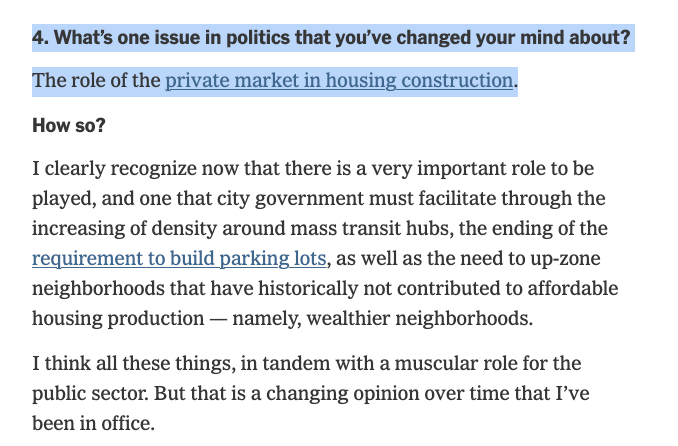
Matthew Zeitlin shares a New York Times interview in which Zohran Mamdani says he has changed his mind about the role of the private market in housing construction. The post quotes a developer touting market-rate projects in democratic socialist districts.
Private developers are essentially bragging about still being able to do market-rate development in districts represented by democratic socialists therealdeal.com/new-york/2026/08/07/nyc-commie…