NYU math professor Tristan Buckmaster says a Tuesday release of 722 AI-generated math papers from OpenAI wiped out entire research programs and damaged early-career mathematicians' careers. The claim is made in a video clip.
Anjney Midha announces hundreds of MI355x and B300 nodes are live on nationalcompute.com, subsidized for .edu and .gov users. The site describes a public-sector compute access program with a capacity tracker.
Trung Phan recalls a DeepMind documentary showing Demis Hassabis's reaction when told AlphaFold could predict all known protein sequences, then its release. He quotes a Bloomberg report that Isomorphic Labs is in early talks to raise funds at a valuation of at least $40 billion.
Still incredible that the DeepMind documentary has footage of exact moment Demis is told that AlphaFold can “easily” predict all known (1-2B) protein sequences “in a month” and he says to do it.
Then, it shows the moment AlphaFold is released to the world.
Isomorphic Labs, an AI-powered drug discovery startup spun out of Alphabet’s Google DeepMind, is in early talks to raise new funds at a valuation of at least $40 billion, according to people familiar with the effort. bloomberg.com/news/articles/2026-10-08/alphabe…
Claude announced that Claude Dashboards and Claude Motion are now in beta. Users can ask Claude to turn data into live dashboards and ideas into animated explainers.
OpenAI announced it is releasing a range of new mathematical results produced by an internal frontier model, consulting the Institute for Advanced Study's Advisory Group on Mathematics and Artificial Intelligence on how to release them, with materials published on GitHub.
We’re releasing a broad range of new mathematical results produced by an internal frontier model.
We’ve been consulting with the independent Advisory Group on Mathematics and Artificial Intelligence at the Institute for Advanced Study, and we have drawn on their advice and public recommendations to inform how we release these results.
Tony Dinh comments that the new service supports image input, quoting an OpenAI Developers announcement of the Decisions API. The API lets apps choose models, tools or actions in near real time and is claimed to be up to 10x faster than GPT-6 Luna via the Responses API.
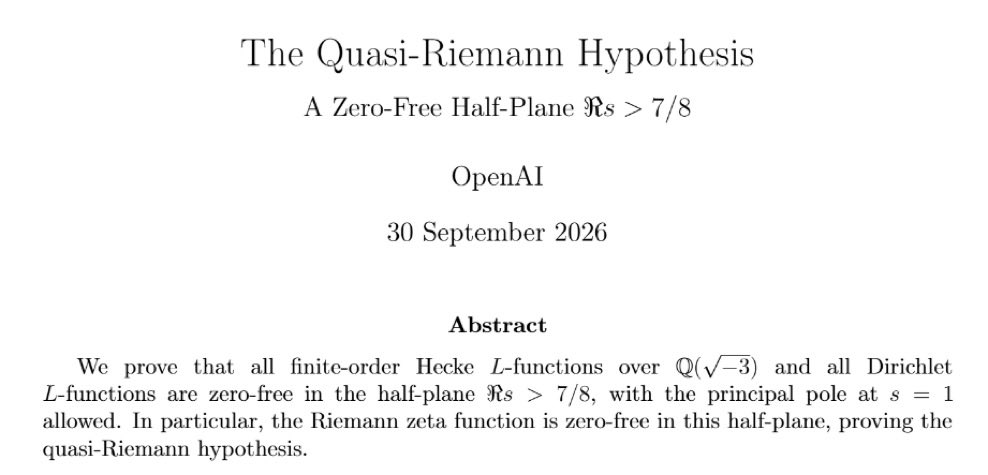
OpenAI released 722 mathematical manuscripts produced by an unreleased internal model, grouped into 372 families of results from about 4,000 research problems, averaging three hours of ChatGPT Pro compute per result. The author highlights claimed results including a zero-free half-plane for the zeta function and a quasi-Riemann hypothesis advance, which remain to be independently assessed.
Ok so I took a closer look at the results, and OpenAIs AI-generated mathematics manuscripts are *even more* significant than I initially thought.
I spent the morning going through it. Some thoughts.
The list is absurd. A zero-free half-plane for the zeta function (Re s > 7/8), which is the first result of its kind in over a century. Hilbert's tenth problem over the rationals. The Hodge conjecture for CM abelian varieties. Irrationality of Catalan's constant. Dozens more.
Any one of these would normally be a career.
But the number that many arent seeing is the following: It's 3. That's the average hours of ChatGPT Pro compute per result. A month ago, Navier–Stokes took them around 10,000 agents and 88 hours. That efficency gain within just a few weeks.
Also OpenAI claims to have solved the quasi-Riemann hypothesis. That alone would be a historic breakthrough in mathematics.
This is a weaker version of the famous Riemann hypothesis, which concerns how prime numbers are distributed. The full hypothesis remains unsolved, but the claimed advance would be enormous in its own right.
Math twitter obviously is shocked. Again: this is literally the intelligence explosion happening right now. 2027 will be the year of Superintelligence. Im now convinced by that.
Grok Bot now has its own email address, which it can use to sign up for services, contact businesses on a user's behalf or schedule meetings. The post includes a photo.
Jennifer Li announces a16z is leading an investment in TypeSafe AI, whose Jev model returns typed decisions directly to code at far lower cost. The post frames it as a new System One model class for software.
Andrew Ng argues that agentic workflows, not just humans, will sharply increase demand for compute, storage, and networking, requiring many more data centers. He notes tool calls such as web search are becoming a bottleneck alongside token throughput.
The Batchby Analytics DeepLearning.AI··✉ newsletter
“We are in the early stage of agents causing demand for compute, storage, and networking to skyrocket.”— Analytics DeepLearning.AI
Derek Thompson shares a quoted passage calling October 6, 2026 probably the biggest day of scientific advancement in history for AI in mathematics. The quoted Josh Gans post discusses OpenAI's Big Maths Day announcement.
"It isn’t an overstatement to say that this is probably the biggest day of scientific advancement in history. I suspect October 6th, 2026, will go down as some form of Judgment Day for AI in mathematics, but it portends so much more."
Bret Taylor says Sierra built the Fleming-1 model to complement its Personal Agent Protocol by detecting when the caller on a phone call is an AI agent. The linked post describes it as Sierra's own model for that purpose.
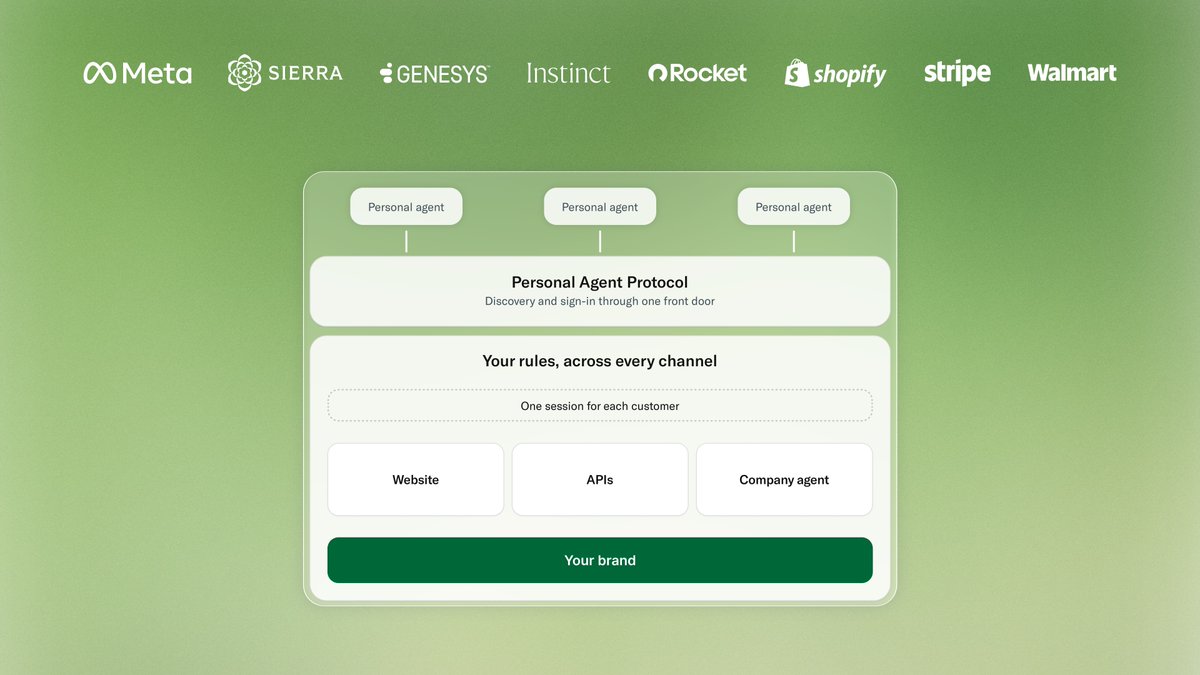
To complement the Personal Agent Protocol, Sierra has developed the Fleming-1 model, which detects when the caller on the other side of a phone call is an AI sierra.ai/blog/caller-id-in-the-age-of-agents
Mario Gabriele interviews Skype co-founder Jaan Tallinn, a longtime AI risk advocate and early Anthropic investor, on his evolving risk estimate, his call for a frontier training moratorium, and hardware-based verification for AI governance. The post is a podcast show-notes and episode summary.
klöss shares a list of accounts to follow for Grok Bot updates, including engineers and product leads. A quoted post from Mattyp summarizes recent updates such as Slack team bots, Google connectors and voice calls.
If you want to be the first to know about Grok @Bot updates, unique use cases, and pro tips, follow these accounts:
@poteto (Lauren) = Grok Bot lead engineer plus regularly roasts Tibo @mattyp = drops digestible vid updates @pengzheng_ = Grok Bot lead designer @johnbai = designs Grok Bot @lingxi = engineering on Grok Bot @shaoruu + @baltaaazr = built the early foundation @SamSokolin = connectors + Android @jediahkatz = behind building the agent @shubgaur = bot whisperer, and gave the founders talk @ericzakariasson = release notes, tips + articles @romanugarte_ = incubated, launched, and now leads product on Grok Bot @joshkim = growth + creator program @vincentzhu = how he uses Bot day to day @kiaraplds = real use-case threads @roshan_s = cohosted the Galaxy livestream @kristaletz = enterprise GTM, runs the Grok Bot GTM community @benln = Grok Bot communities, meetups + ship recaps
Bookmark this. They’re the reason why the Grok Bot changelog is shipping at an insane pace. Follow them and learn.
0:00 Main @Bot 1:32 Engineering updates 2:18 Knowledge work and Google connectors 3:00 Team Bots in Slack 4:15 Team Bot voice calls and status lines 4:39 Plugin search with Command K
Dan McAteer argues OpenAI is downplaying its new mathematical results, noting reasoning models went from failing basic arithmetic to solving long-unsolved problems in two years, and predicts AI will revolutionize all of science.
We’re releasing a broad range of new mathematical results produced by an internal frontier model.
We’ve been consulting with the independent Advisory Group on Mathematics and Artificial Intelligence at the Institute for Advanced Study, and we have drawn on their advice and public recommendations to inform how we release these results.
Deedy highlights a claimed OpenAI mathematics release, conditional on verification, and argues that LLMs have made major progress on several Millennium Prize problems, concluding that AI has largely reached human-level cognitive ability.
OpenAI’s math release is, in the words of Opus, “the single most consequential mathematical release ever” *
LLMs have how made substantial progress on 4 of 7 Millenium Prize problems: Navier-Stokes (claimed), Riemann, Hodge and Birch-Swinnerton-Dyer. Poincaré was solved in 2003. The two left are P v NP and Yang Mills. *conditional on verification
On average, each OpenAI result used only 3hrs of thinking compute on their new unreleased models.
Two years ago, models said 9.11 > 9.9. Today, we have results that the smartest human minds have not been able to achieve in their entire lives. It is clear that data, compute and algorithms scale. Every model generation (3mos) has made substantial intelligence progress.
It also becomes incredibly hard to not believe that all knowledge work will change monumentally over time. The things AI can not do in the foreseeable future are very likely context-bound (don’t have access to the right information) than intelligence bound. Some might argue they are also creativity-bound or judgement-bound (what should I work on), although it can be argued that future generations could solve for this (given, say, the advancement in research taste for models over time).
AGI is defined as surpassing human capabilities on virtually all cognitive tasks. By most interpretations of that definition, we are there. The domains humans are still better than AI, such as, robotics / physical world control (data-bound?), natural science research (data-bound), some creative domains like writing, movies, music (creativity-bound), super long tasks (context-bound), choosing problems to solve (creativity-bound) and maybe human relationships management (meat-proxy bound?). In many ways, we have achieved AGI.
Bill D'Alessandro says he received a draft 2025 tax return showing $117,360 owed, then asked ChatGPT Astra to review it against source documents. He reports the 90-minute review produced a report showing a $191,173 refund, which his accountant agreed was correct, and recommends pairing frontier LLMs with past tax returns.
I just got the draft of my 2025 tax return - it says I owe $117,360 of tax. On top of what I already paid.
Oof.
But it didn't feel right to me.
I asked ChatGPT Astra to do a secondary review, ticking and tying every number to source documents. Max effort. It ran for 90 minutes.
Output - a 15 page report. It says I'm actually due a $191,173 REFUND.
I reviewed Astra's work line by line with my accountant. He agreed, the LLM is correct.
I was about to send Uncle Sam $117,360. Instead, I'm getting back $191,173.
That's a swing of $308,533 (!!!!!!)
The LLM couldn't have done my tax return from scratch - I still need my accountant. But for massively complex detail oriented work, and LLM is the best thought partner you can have.
Connect a frontier LLM to your email and file storage, then ask it to review your past tax returns. You never know what it might find. My prompt is in the next tweet.
Bret Taylor announces the Personal Agent Protocol, an open standard being developed by Meta and Sierra with partners including Genesys, Shopify, Stripe and Walmart. It defines how personal agents interact with businesses and is open for anyone to implement.
A quoted post says Ben Affleck discussed writing Python scripts, understanding convolutional neural networks and getting private looks at Google and OpenAI video models. The accompanying post by Greg Hunkins is a playful video riff on the comments.
Ben Affleck reveals he writes Python, understands convolutional neural networks, worked extensively with GPUs, and used his celebrity status to get private looks at Google and OpenAI’s video models
“I’ve always been kind of into computers since I was young. Then, when film started to move from analog film to digital, I became more interested in that aspect of it. The visual-effects workflow for many years has included machine learning, so I can write pretty shitty Python scripts and stuff like that.
“With convolutional neural networks, which were the precursors to what the transformer can do…
Dharmesh Shah argues that personal AI agents from OpenAI, Meta and xAI can connect data scattered across apps, letting users ask cross-app questions in plain English. He notes that context quality drives usefulness.
simple.aiby Dharmesh Shah··✉ newsletter
“When an agent can see across those pieces, it becomes a question you just ask in plain English.”— Dharmesh Shah
Mustafa Suleyman shares an essay from The Humanist Review in which economist Daron Acemoglu argues AI will replace about 5% of human work tasks over ten years and adds roughly 1.5% to GDP. Acemoglu calls for pro-worker AI and changes to labor taxes, antitrust and data payments.
This is the prediction Nobel laureate Daron Acemoglu makes in the first issue of The Humanist Review, our new magazine exploring the future of AI, published by MAI.
He argues we need to stop building AI to replace people, and start building it to make them better at their jobs. 52% of Americans are worried about AI's impact on their jobs. The fear is overblown, and it's steering how we build AI. AI isn't in the productivity statistics yet. Most firms using it aren't seeing real gains. Expect roughly 1.5% added to GDP over 10 years, not a revolution. Electricity took decades to spread. New York and London had power stations by 1881, yet only about half of factories and homes used it by the 1920s. AI's adoption will likely be even slower, because companies have to reorganize around it. Even 99% accuracy isn't enough for full automation. The last 1% is the hard part. We're making a mistake by forcing AI to mimic human intelligence. The two are fundamentally different, so the goal should be to pair them, not to have one take over everything. We shouldn’t expect much more than about 5% of what humans do to be replaced by AI. The better path is pro-worker AI: tools that make people better at their jobs, and they're buildable today. The US taxes labor at over 25% and capital at close to zero, which effectively subsidizes automation. The seven largest tech companies make up 60% of the NASDAQ. That concentration crowds out new ideas. Read his full essay: humanistreview.ai/issue-1/acemoglu-ai-replace-…
Ilya Sutskever posted that people who value intelligence above all other human qualities are going to have a bad time, a short reflective remark on AI and human values.
The official Grok Bot account announces that it can now search, read and monitor posts on X. The post is a short video announcement with no further details.
In a quoted interview, Ben Affleck says he writes Python, understands convolutional neural networks and has worked with GPUs, and that he has visited Google and OpenAI to see their video models. The post also quotes Andy Bechtolsheim saying AI has raised optics demand roughly tenfold, with much more growth ahead.
Ben Affleck reveals he writes Python, understands convolutional neural networks, worked extensively with GPUs, and used his celebrity status to get private looks at Google and OpenAI’s video models
“I’ve always been kind of into computers since I was young. Then, when film started to move from analog film to digital, I became more interested in that aspect of it. The visual-effects workflow for many years has included machine learning, so I can write pretty shitty Python scripts and stuff like that.
“With convolutional neural networks, which were the precursors to what the transformer can do, which is much more computation simultaneously, you would do things like look at what’s called a tensor. That’s the numerical translation of a visual image in numbers, like the batch number, the frame number and the red, green and blue values of each pixel in each frame. It’s just that simple. That numeric is called a tensor.
“You’d use a convolutional neural network to identify patterns that reveal what’s called edge detection or feature extraction, which is identifying patterns well enough to know, this is where the window ledge is, so we can more easily take the green-screen image out and replace it with something.
“That was familiar to me early on because, prior to Artists Equity, I had a small visual-effects company. I’ve worked with GPUs a lot too. The visual-effects guys said, ‘Hey, you should see. There are a couple: Google and this other company, OpenAI, are doing really interesting stuff with transformers in video.’
“I’ve learned that I can actually just call up and go, ‘Hey, it’s Ben Affleck. Can I come see what you’re doing?’ Sometimes people say yes, to my astonishment.”
$ANET Andy Bechtolsheim says AI has made optics demand about 10 times bigger in five years and the industry is only at the "very beginning"
"So I guess I don't need to tell you that AI has been driving this incredible increase in demand for high-speed optics, which is probably now 10 times bigger than it used to be five years ago..."
"And what I want to talk to you today is that we're not at the end of this journey, but rather the very beginning. There's easily another order of magnitude increase in bits needed for the next generation kind of data centers."
 ▶
▶